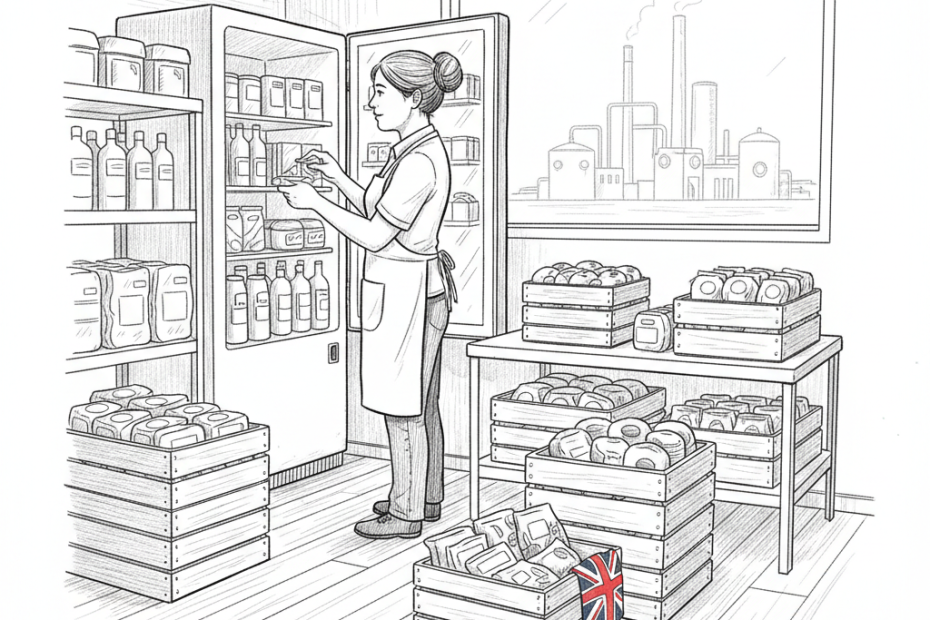
The government has agreed to invest up to £100 million to reopen the mothballed Ensus plant on Teesside as part of a contingency plan against possible carbon dioxide shortages linked to the Iran war. That may sound like a niche industrial story, but for plenty of smaller firms it is not. CO2 sits quietly behind parts of the food, drink and packaging chain, which means disruption can travel further than most business owners expect.
For small pubs, cafés, caterers, butchers, food producers and local wholesalers, the practical question is not whether they buy industrial gas directly. It is whether a squeeze higher up the chain starts showing up in packaging availability, drink supply, meat processing, or fresh-food costs. The government’s move suggests ministers are worried enough about that risk to spend real money before a wider shortage bites.
What has happened
According to BBC reporting, the Ensus site produces bioethanol and also generates CO2 as a by-product. It was shut after a UK-US trade deal removed a tariff on American ethanol imports, making the plant’s main product less competitive. Now it is being brought back with government backing for an initial three-month period.
The timing matters. Oil and gas prices have jumped sharply since military action involving Iran began at the end of February, while concerns have also grown about pressure on European fertiliser producers, another source of CO2. The BBC said CO2 is used to stun livestock during slaughter, keep food fresh in packaging and support fizzy-drinks production. The Independent also reported that the grant was signed off by Business Secretary Peter Kyle and is intended as a first major government intervention to shore up a vulnerable supply chain.
There is a regional angle too. The Teesside plant employs around 100 people directly and supports a wider UK supply chain worth roughly 3,000 jobs, according to comments carried by the BBC. So this is partly about resilience in critical sectors, but it is also about avoiding another avoidable industrial weak spot in the North East.
Why SMEs should care
Small firms usually feel this kind of problem later than big buyers and with less negotiating power. A national CO2 scare does not need to turn into an official emergency before it becomes expensive. It can show up as supplier warnings, thinner availability, awkward substitutions, shorter ordering windows, or higher costs hidden inside food, drink and logistics invoices.
That matters most for hospitality and food businesses already operating on thin margins. If you run a pub, café, takeaway, event caterer, small drinks brand or food-processing business, you are already dealing with a wider running-cost picture shaped by energy and transport volatility. We looked at that broader squeeze in our piece on fuel-duty uncertainty and running-cost pressure for UK small businesses.
Even firms outside food and drink should not dismiss this as someone else’s problem. If your customers are hospitality venues, convenience retailers, wholesalers or local manufacturers, any fresh disruption to inputs and packaging can quickly feed into delayed orders and cashflow strain. That is one reason strong payment discipline still matters, especially when supply chains get twitchy and businesses spend more time protecting working capital.
What to check this week
First, ask your key suppliers whether they expect any short-term disruption or cost changes linked to CO2, chilled packaging or drinks supply. You do not need to panic-buy. You do need early visibility, especially if your business depends on fresh stock, carbonated drinks, or regular event catering.
Second, review where you are exposed indirectly. A lot of firms will not see “CO2 surcharge” on a bill, but they may see changes in meat availability, packaging lead times, bottled or canned drink supply, or minimum order rules from wholesalers trying to manage risk.
Third, tighten short-term margin tracking. If a supplier does raise prices or reduce flexibility, you need to know which lines can absorb it and which cannot. That is particularly important for smaller operators with fixed-price menus, event quotes, or narrow seasonal windows.
Finally, keep this in proportion. The Ensus restart is a contingency move, not proof that a full-scale shortage is already here. But it is a useful warning that supply-chain resilience is still a live issue for British SMEs, even when the weak point is something most firms rarely think about.
The practical takeaway
The Teesside restart is best read as an early warning rather than a niche industrial rescue. Government would not be putting up to £100 million on the table for three months of support if it thought the risk was trivial. For smaller businesses, especially in food, drink and hospitality, the sensible move is to check supplier exposure now and keep a closer eye on margin-sensitive lines.
You do not need to rewrite your whole plan because of one plant. But if your business depends on chilled food, drinks, packaging or tight stock timing, this is exactly the sort of behind-the-scenes problem that can become your problem fast. The firms that ask practical questions early usually cope better than the ones that assume the supply chain will sort itself out.
Sources
- BBC News, UK CO2 plant to reopen in Iran war contingency plan, published 26 March 2026
- The Independent, Peter Kyle clears reopening of CO2 plant amid fears of Iran-linked shortages, published 26 March 2026