The government’s new push to move “further and faster” on UK energy security may sound like a big-picture policy story, but there is a practical small-business angle hiding inside it.
On Sunday, Energy Secretary Ed Miliband set out a package that includes bringing Britain’s next renewables auction forward to July, speeding up parts of the Warm Homes Plan and opening the way for “plug-in solar” panels to be sold in the UK for the first time. Ministers also repeated that they are watching fuel and heating-oil markets closely after the latest spike in global energy costs.
For SMEs, the immediate question is not whether this solves energy costs overnight. It does not. The more useful question is whether it points to cheaper, more flexible energy options over time and whether firms should start planning now instead of waiting for the next bill shock.
What the government has announced
According to the government, the package has three main parts. First, it wants to accelerate the next annual renewables auction, giving investors earlier clarity on new clean-power projects. Second, it says lessons from work to speed up nuclear development will be applied more widely to other infrastructure, including renewables. Third, it wants to make plug-in solar available in Britain for the first time.
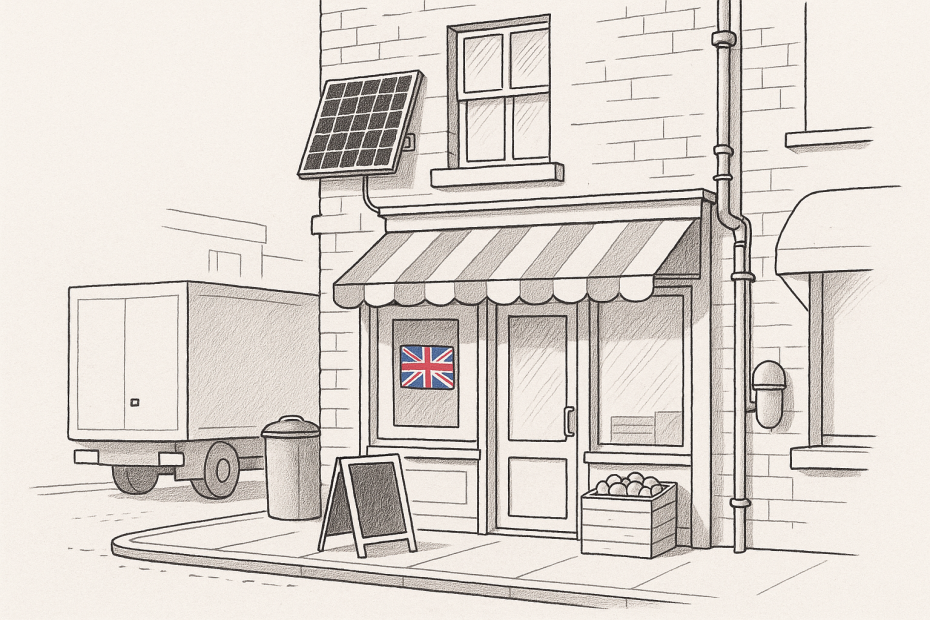
That last point is the most interesting for smaller firms. Plug-in solar is already used in parts of Europe and is designed to be simpler than a full rooftop installation. The government says the panels could be placed in gardens, on walls or on balconies and plugged into a mains socket once standards and regulations are in place.
Why small businesses should pay attention
Energy policy often feels remote until it lands in a monthly direct debit, supplier surcharge or weaker customer demand. But this package matters because many small firms are still operating in an environment where fuel, electricity and heating costs can move quickly.
A village café, salon, workshop, guesthouse or convenience shop does not need to be a major energy user to feel the pressure. Higher utility bills reduce margin directly, while higher household energy costs can also leave customers with less money to spend. That demand squeeze is part of the wider caution we discussed in our recent piece on the UK economy flat in January.
There is also a second group of businesses that should watch this closely: firms in rented or smaller premises. If plug-in solar does become a realistic UK option, it could be especially interesting for businesses that cannot easily install a full rooftop system because they lease space, occupy part of a building or lack the capital for a bigger project.
What this could mean in practice
In the near term, the announcement is more signal than saving. Small firms should not assume their costs will suddenly fall because a renewables auction is being brought forward. These are structural changes, not next-week discounts.
Still, the direction of travel matters. The government is clearly trying to reduce the UK’s exposure to volatile fossil-fuel markets while increasing energy options that can be deployed faster. For SMEs, that suggests two practical takeaways.
First, energy resilience is becoming a business-planning issue, not just a facilities issue. Owners should be looking at whether they can reduce exposure through insulation, equipment upgrades, smarter usage patterns or different supplier arrangements.
Second, businesses should keep an eye on low-cost energy technologies that were previously out of reach or not allowed. Plug-in solar will need proper standards before it reaches the market, but if it arrives in a workable form it could open up new options for some smaller premises.
For firms already worrying about transport and delivery costs, this sits alongside the pressure we covered in our recent look at fuel-price scrutiny and what businesses should watch next. In other words, this is not just about electricity generation. It is about how exposed your business is to energy volatility overall.
What SMEs should do now
Owners do not need to wait for a new scheme to start preparing. Review where energy hits your profit and loss account most sharply. Check whether the biggest risks are heating, refrigeration, cooking, machinery, lighting, deliveries or customer footfall.
If you operate from leased premises, speak to your landlord or managing agent about what energy improvements are realistic over the next year. If you have some outside space, keep a watching brief on plug-in solar standards and product availability.
Most importantly, avoid treating energy as background noise. The firms that cope best with volatile costs are usually the ones that keep reviewing them, not the ones that only notice when margins have already been squeezed.
The practical takeaway
The government’s latest announcement will not deliver instant relief for small businesses. But it does point towards a UK energy market where smaller, more flexible and more local options may become more realistic.
For SMEs, that makes this a planning story. Watch for new rules on plug-in solar, keep monitoring fuel and utility exposure, and use this period to think about resilience before the next shock arrives.
Sources
- UK government news release, Government to go “further and faster” in becoming energy secure, published 15 March 2026
- BBC News, Rachel Reeves to offer support over rising heating oil costs, published 14 March 2026