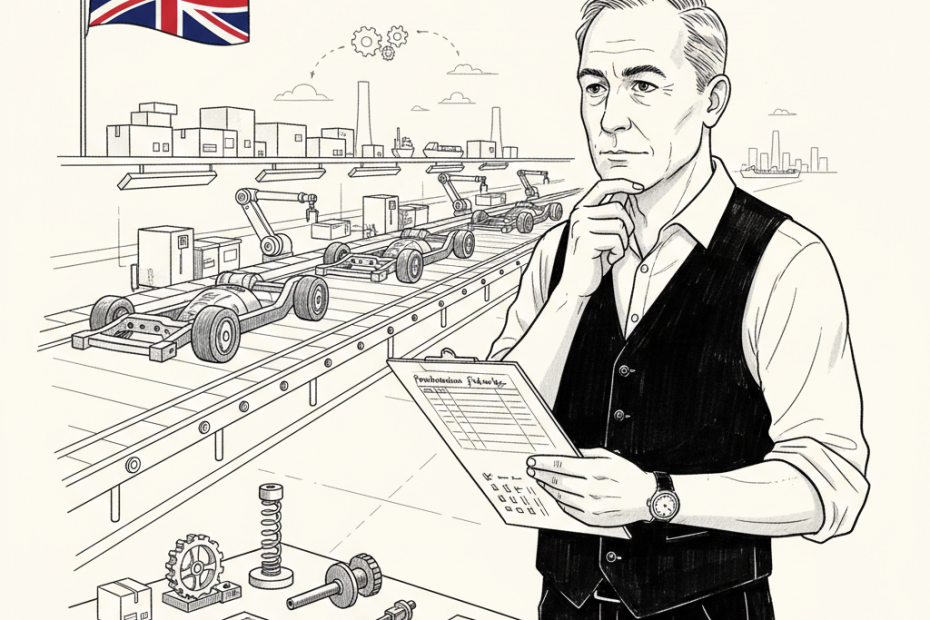
Nissan’s plan to merge two production lines at its Sunderland plant is a reminder that big manufacturing decisions can matter well beyond the factory gate. The company says the move will not lead to job losses at Sunderland, but it sits alongside wider European cost-cutting and a search for better use of spare capacity at one of the UK’s most important car plants.
For small manufacturers, engineering firms, logistics providers and service businesses around the automotive sector, the practical question is not whether Nissan is leaving Sunderland. It is how changing production patterns, possible third-party use of the plant, and pressure on carmakers’ costs could affect order books, cash flow and supplier planning over the next year.
What has happened
According to the BBC, Nissan plans to consolidate production from two lines to one at Sunderland, where it builds models including the Leaf, Juke and Qashqai. The company said no jobs would be lost through the line merger, while wider European plans include about 900 job cuts and changes in areas such as warehousing and office roles.
The move is part of Nissan’s wider recovery plan, intended to make the business leaner and more resilient. The Sunderland change also leaves a second production line available for possible use by another manufacturer, with the BBC reporting that Nissan has been in talks with several companies, including China’s Chery.
That makes this more than a single-company efficiency story. Sunderland remains a major anchor for the North East’s manufacturing base, and any shift in output, model mix or plant utilisation can ripple through suppliers, contractors, training providers and local services.
Why it matters to SMEs
Large manufacturers often sit at the centre of a wider SME ecosystem. Small firms may supply components, tooling, maintenance, cleaning, packaging, specialist engineering, haulage, recruitment, training, catering, IT support or professional services. Even businesses that do not sell directly to Nissan can be exposed through second- and third-tier suppliers.
If one line is merged into another, suppliers may see changes in scheduling, delivery frequency, stockholding, shift patterns or the type of parts in demand. If another carmaker eventually uses spare capacity, that could create fresh opportunities, but it may also mean different standards, procurement systems, volumes and payment expectations.
For SMEs already dealing with tight margins, uncertainty can be as important as the final decision. A supplier may need to decide whether to hold more stock, delay investment, cross-train staff, or diversify customers. That can put pressure on working capital, especially where payment terms are long or demand is uneven. The same issue sits behind our recent coverage of how late payments continue to squeeze UK SMEs.
What suppliers should check now
First, map your exposure. If your business serves Nissan, a direct supplier, or a local contractor linked to the plant, estimate what share of turnover depends on that work. Include indirect exposure, such as customers whose own sales depend heavily on automotive manufacturing.
Second, speak to key customers early. Ask whether delivery schedules, forecast volumes, specifications or purchasing contacts are expected to change. Keep the conversation practical rather than speculative: what will be ordered, when, and under what terms?
Third, review cash-flow buffers. A production transition can mean delayed orders, altered stock needs or uneven invoicing. SMEs should stress-test the next few months against slower payments, lower volumes or sudden short-notice work. If bank facilities, invoice finance or overdraft headroom may be needed, it is better to look before pressure builds.
Fourth, check contracts and dependencies. Some suppliers may have exclusivity, minimum-volume assumptions, penalty clauses or tooling commitments that only make sense at certain production levels. If a customer changes plans, understand whether your business has protection, flexibility or a renegotiation point.
Fifth, keep an eye on diversification without overreacting. If another manufacturer uses the spare line, local suppliers with strong quality systems and automotive experience may be well placed. But new customers can mean different onboarding, audits, insurance requirements and payment processes. Treat potential new work as an opportunity to prepare for, not as guaranteed replacement demand.
The practical takeaway
The strongest immediate message for SMEs is to avoid complacency and panic in equal measure. Nissan has said the Sunderland line merger itself will not cost plant jobs, but a major manufacturer changing how it uses capacity is still a signal for suppliers to review exposure and resilience.
Small firms in and around the automotive supply chain should use the news as a prompt to check forecasts, customer concentration, cash flow and contract terms. Those that understand their dependencies now will be better placed to handle disruption, and to move quickly if spare capacity at Sunderland does turn into new manufacturing work.
Sources: BBC News reporting on Nissan’s Sunderland line merger and European job cuts.