UK cleantech SMEs with proven low-carbon technology have a short window to check whether a new United Nations-backed funding call could fit their next overseas demonstration project.
The United Nations Industrial Development Organization has opened a call for proposals under the Accelerate-to-Demonstrate Facility, supported by the UK Government’s Ayrton Fund. The call is aimed at clean energy and industrial decarbonisation projects in developing countries, with submissions due by 3pm UK time on 18 June 2026.
For small firms working in areas such as smart energy, energy storage, electric mobility, critical-minerals recycling, industrial decarbonisation or clean hydrogen, the opportunity is worth a quick but disciplined review. The grants are not designed for early research ideas. They are for technologies that are already proven and ready to be demonstrated at industrial scale.
What has opened?
The current A2D call invites full written grant proposals for large-scale demonstration projects that can be implemented, commercialised and scaled. According to the government announcement, the funding is focused on practical use cases that can deliver real-world emissions reductions in developing countries.
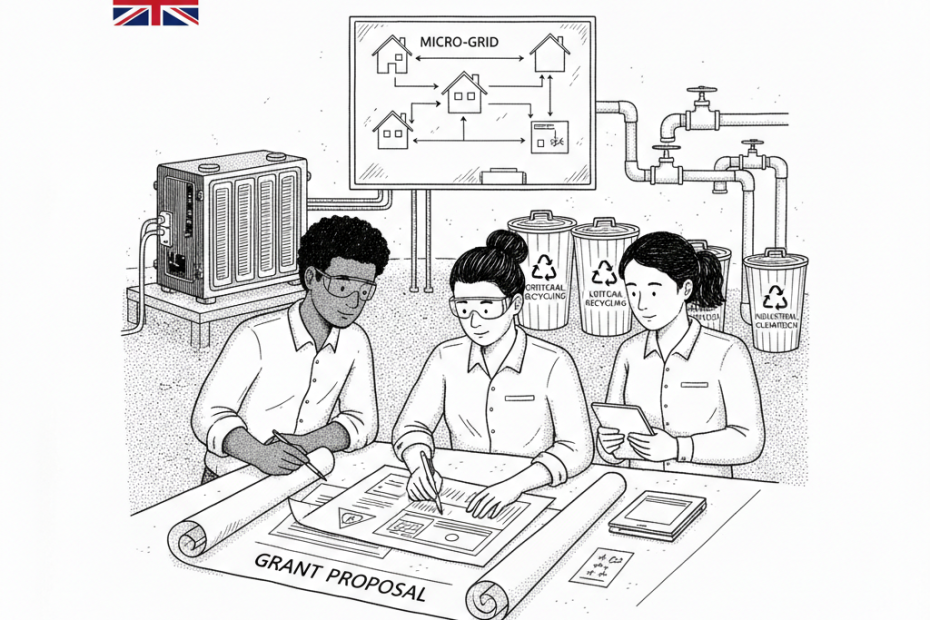
The four broad areas listed for this round are critical minerals, smart energy, industrial decarbonisation and clean hydrogen. That could include low-carbon ways to recover and recycle critical minerals from waste streams, digital tools for smarter power systems, advanced energy storage, micro-grids, smart charging networks, fleet-management technology, carbon capture and utilisation approaches, and improved hydrogen systems.
Grants are expected to sit in the range of $1 million to $5 million, with a 2.5 to four-year implementation phase. All supported activity must be completed no later than 14 December 2030.
Why this matters for SMEs
Many smaller UK engineering, software and clean-energy firms sit in the difficult gap between a successful pilot and a fully commercial international deployment. A grant of this size can help bridge that gap, but only if the business already has the technical evidence, delivery partners and project management capacity to move quickly.
That makes this a selective opportunity rather than a general innovation grant. SMEs should avoid treating it as a speculative funding lead. If the technology is still at the laboratory stage, or if the overseas delivery model has not been thought through, the call is unlikely to be the right fit.
For firms that are closer to market, however, it could support a serious demonstration in sectors where demand is likely to keep growing: cleaner industrial heat, resilient local power systems, battery and mineral supply chains, hydrogen efficiency, and digital tools that help energy systems use renewables more effectively.
It also underlines a wider point for small business owners: funding increasingly follows projects that can show both commercial potential and measurable impact. That same discipline matters in domestic grant searches too. If cash flow is tight while waiting for customers, contracts or grant decisions, our earlier piece on late payments and SME cash flow is a useful reminder to keep working-capital assumptions realistic.
What to check before applying
Before committing time to a proposal, SMEs should read the UNIDO procurement notice and test the project against three practical questions.
First, is the technology demonstrably ready? The announcement says A2D does not support planning-stage work, research and development, or early-stage pilot testing. Applicants will need to show that the proposal is ready for a larger demonstration and not simply a promising concept.
Second, is there a credible deployment route in an eligible developing country? A strong UK product on its own is unlikely to be enough. The project needs local relevance, delivery partners, a realistic implementation timetable and a clear route to market after the demonstration phase.
Third, can the company handle the administrative burden? International grant-funded projects usually require evidence, reporting, controls and procurement discipline. Smaller firms should be honest about whether they have the management bandwidth to deliver without stretching the core business too thin.
The takeaway
The 18 June deadline gives potential applicants only a few weeks to decide whether to move. For most SMEs, the sensible first step is not to start writing immediately, but to check eligibility, partner readiness, match funding or cost assumptions, and whether the proposed demonstration is genuinely implementation-ready.
If those pieces are already in place, this could be a meaningful route to take a UK clean-energy technology into a larger international setting. If they are not, it may still be useful market intelligence: future funding rounds are likely to keep rewarding companies that can prove their technology works, can scale it responsibly, and can explain the commercial case in plain terms.