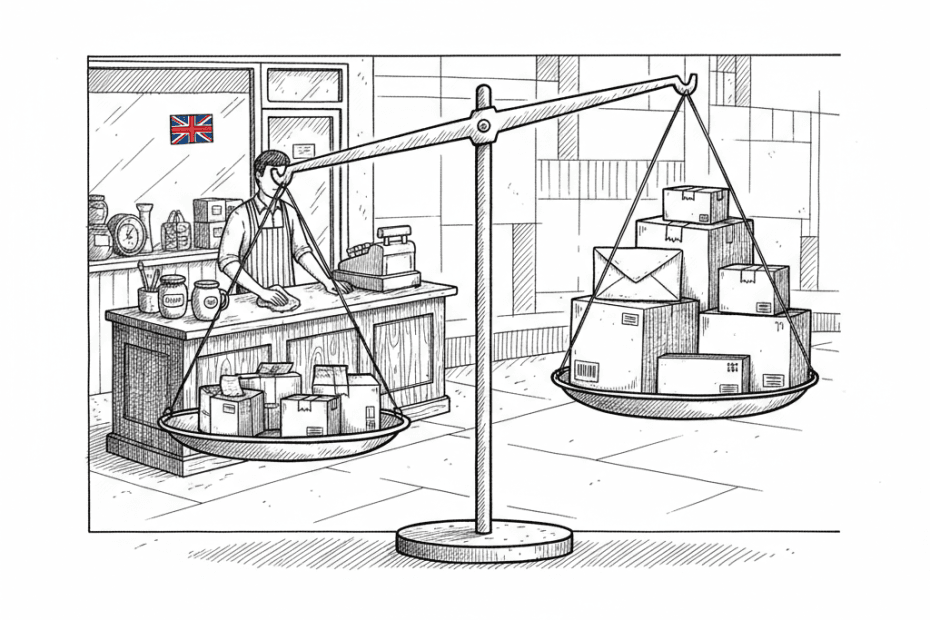
The government has set out a package of tax and customs changes aimed at making competition fairer between UK high street businesses and online sellers. For small retailers, hospitality firms and local employers, the most immediate point is not a new rule taking effect tomorrow. It is that ministers are moving two areas that could reshape pricing, compliance and online competition over the next few years.
On 23 June 2026, HM Revenue & Customs said the government will bring forward planned changes to low-value imports by six months. The change would remove customs duty relief on goods valued at £135 or less, meaning those imports would become subject to customs duties from October 2028. The government says the aim is to reduce the gap between overseas sellers shipping cheap goods into the UK and businesses that already face UK operating costs, tax rules and local overheads.
The same announcement also points to a review of how VAT is collected from businesses trading through online marketplaces. A linked HMRC consultation proposes extending existing online marketplace VAT liability rules so they can cover sales by UK-based businesses when the goods are in the UK at the point of sale. The consultation closes at 11:59pm on 18 August 2026.
This matters because many small firms are competing with sellers that customers see on the same screen but that may not face the same compliance pressure. A shop, wholesaler, food business or independent brand that pays VAT correctly can be undercut by sellers using platforms in ways that make tax harder to police. HMRC says non-compliance remains a problem among both overseas and UK-based businesses, and that it can distort competition for compliant firms online and on the high street.
For independent retailers, the useful question is whether the reforms make pricing more transparent without creating new uncertainty for legitimate sellers. The low-value import change is still some way off, but it could affect businesses that buy stock from overseas suppliers, sell imported low-cost goods, or compete directly with overseas parcels landing with UK consumers. Owners should watch how the detail develops, particularly around customs processes, landed costs and any change to delivery times or customer expectations.
The marketplace VAT consultation is more immediate for firms that sell through platforms. If liability shifts further towards marketplaces, some small sellers may welcome clearer enforcement against rivals that avoid VAT. Others will want reassurance that platform checks, data requests or account controls do not create unnecessary admin for businesses that are below the VAT threshold or already compliant.
The government says the consultation is looking at design features, including how to minimise the impact on businesses that are not required to register for VAT. That point is important for sole traders, micro-retailers and young ecommerce brands that use marketplaces as a route to customers. They should not assume the proposals will automatically mean a new VAT bill, but they should follow the consultation because platform processes can still affect listing, payment and record-keeping routines.
There is also a wider high street angle. Ministers say revenue raised from improving compliance will go towards business rates improvements for pubs, restaurants, hotels and other high street businesses. That promise will matter only when firms can see the practical rates changes that follow. BritishSME has recently covered how weak demand and pressure on margins can make small cost differences harder to absorb; fairer competition is useful only if it translates into a more manageable trading environment.
Small businesses can take a few sensible steps now. Retailers that import goods should review which products fall near or below the £135 threshold and check how exposed their margins are to future duty changes. Businesses selling through marketplaces should keep VAT records, product locations and platform correspondence tidy, especially if they sell both through their own website and through third-party platforms. High street firms that feel affected by online undercutting may also want to respond to the consultation with concrete examples rather than general frustration.
The headline is encouraging for many local businesses: government is recognising that online competition and tax compliance are now part of the same conversation. The detail will decide whether this becomes a practical boost for compliant SMEs or another layer of platform-driven admin. For now, the strongest move is to watch the consultation, understand exposure to low-value imports, and keep clean records so any change can be handled without a scramble.
Sources: GOV.UK announcement on high street tax and customs reforms; HMRC consultation on online marketplace VAT liability.