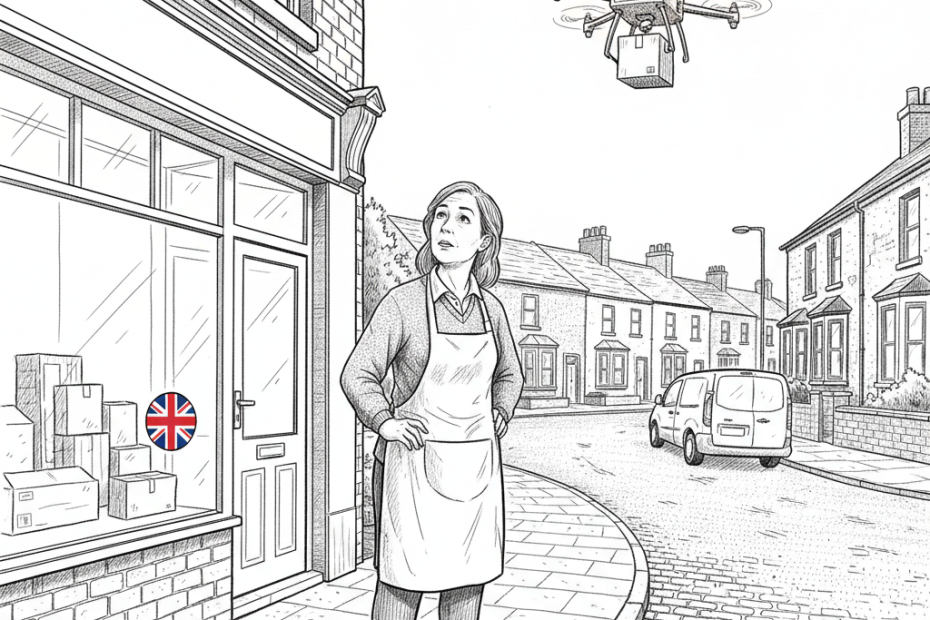
Amazon has begun delivering some UK parcels by drone from its Darlington site, in a limited launch that is still far from normal high-street delivery. For small retailers, couriers and local service firms, the useful point is not that drones will replace vans tomorrow. It is that another part of the delivery market is starting to test faster, more local and more automated fulfilment.
The BBC reported on 7 May 2026 that Amazon is delivering eligible parcels within a 7.5-mile radius of its fulfilment centre in Darlington, County Durham. The service is currently limited: parcels must weigh less than 5lb, or about 2.2kg, and customers need a suitable garden or yard for the drop-off. Amazon says the UK drones can currently deliver within two hours, while its average drone delivery time in the US is 36 minutes.
What has changed
This is a small operational launch, not a nationwide delivery reset. Amazon is starting with everyday items such as beauty products, batteries and cables, using its MK30 drone. The BBC said the company expects a maximum of ten flights an hour, or up to 100 deliveries a day on weekdays, from the Darlington operation.
That matters because it puts drone delivery into the real UK retail environment: ordinary homes, mixed public reaction, weather, gardens, noise concerns, planning questions and practical limits around parcel size. It also shows why the technology may expand slowly. Dense city centres, flats, high-rise buildings and busy streets are harder to serve than homes with open drop-off space.
For SMEs, the immediate lesson is not to buy drone software or overhaul delivery promises. The more realistic question is how customer expectations will shift if very fast delivery becomes normal in more categories. Large platforms do not need drones everywhere to change what customers think is possible.
Why small retailers should pay attention
Independent retailers cannot match Amazon’s logistics budget, and most should not try. But small firms compete on trust, local knowledge, availability, advice and service. If faster fulfilment becomes a louder part of the customer conversation, SMEs need to be clear about where they can win and where they should avoid a race they cannot afford.
For a local hardware shop, pharmacy supplier, gift retailer, pet business or office-products seller, the threat is not only a drone overhead. It is the customer asking whether a low-value item can arrive today, with less friction and clearer tracking. That pressure already exists through same-day couriers and marketplace delivery. Drone trials simply make the direction of travel more visible.
There may also be opportunities. Local shops can offer click-and-collect, reserve-and-collect, local courier partnerships, stock visibility, emergency orders for nearby customers, or paid delivery windows that are realistic for their area. Some firms may find that a simple same-day local run once or twice a day beats trying to imitate national platforms.
The point is to build a delivery promise that is reliable rather than spectacular. A small retailer that says “order by 2pm for local delivery this evening” and consistently delivers may create more loyalty than one that advertises speed it cannot control.
What to check now
First, review the products customers most often need quickly. These may not be the highest-margin items. They are usually urgent, practical and easy to pick: cables, replacement parts, pet supplies, workwear, basic tools, consumables or repeat purchases. If those items are hard to find on your website or stock is not visible to staff, speed will not help.
Second, map your genuine local delivery radius. Many SMEs talk about local delivery without knowing which postcodes are profitable, which routes are awkward and what minimum order value is needed. A clear delivery map can help avoid margin leakage, especially while wider running costs remain under pressure. Firms with vans or regular routes may also want to revisit our note on fuel duty uncertainty and small business transport costs.
Third, improve communication before adding complexity. Customers often value accurate timing more than raw speed. Confirmation emails, collection updates, honest cut-off times and quick phone support can make a small retailer feel more dependable than a larger seller with vague tracking.
Fourth, keep an eye on security and fraud. More delivery options can mean more missed-drop disputes, impersonation attempts or confusion about where parcels were left. SMEs should keep simple evidence trails for local drops and train staff not to override procedures when a customer is in a hurry.
The practical takeaway
Amazon’s Darlington drone launch is still limited, and many UK customers will not see a drone delivery for some time. The useful takeaway for SMEs is strategic rather than technical: fast fulfilment is becoming another part of customer service, but speed only helps when it is profitable, repeatable and trusted.
Small businesses should use this moment to check whether their own delivery and collection promises are clear. If the answer is no, the best response is not a drone. It is better stock information, cleaner cut-off times, realistic local delivery, and a service promise that customers can rely on.
Source: BBC report on Amazon’s first UK parcel deliveries by drone.