The first amber heat-health alert of 2026 is a useful prompt for small employers to check how they manage hot working conditions, especially where staff are on the road, outdoors, in kitchens, workshops, warehouses or busy customer-facing premises.
The UK Health Security Agency has issued an amber heat-health alert for the West Midlands, East Midlands, East of England, South East and London from 2pm on Friday 22 May until 5pm on Wednesday 27 May. Yellow alerts are also in place for the North East, North West, South West, Yorkshire and the Humber over the same period.
What the alert means
UKHSA says the amber alert means likely impacts include increased use of healthcare services by vulnerable people and a higher risk to health for people aged over 65 or those with pre-existing health conditions, including respiratory and cardiovascular diseases.
The public advice is simple but relevant to workplaces too: avoid the strongest sun where possible, keep cool, drink fluids, watch for signs of heat exhaustion and heatstroke, and plan physical activity for cooler parts of the day. UKHSA’s hot weather guidance also notes that people who work in manual labour or spend a lot of time outside are among those at higher risk in hot weather.
For small firms, this is not just a health story. It can affect staffing, deliveries, productivity, customer service, vehicle use, equipment, uniforms, stock storage and the way managers plan busy shifts. The impact may be particularly clear for trades, construction support firms, market traders, food businesses, hospitality operators, delivery teams, care-related services and independent retailers with poorly cooled premises.
There is no simple maximum temperature rule
One point often causes confusion: there is no legal maximum workplace temperature in the UK. The Health and Safety Executive says no meaningful upper limit can be imposed because workplaces vary so much, from offices to bakeries and foundries.
That does not mean employers can ignore heat. HSE says employers must still follow health and safety law, including keeping the temperature at a comfortable level and providing clean and fresh air. In practice, small employers should treat a heat alert as a trigger to review risks and make sensible adjustments, not as a reason to wait for a magic temperature threshold.
The right response will differ by workplace. A small office may need blinds, ventilation and flexible start times. A takeaway kitchen may need more breaks, cool drinking water and a check on ventilation. A delivery firm may need route planning, vehicle checks and reminders not to leave staff sitting in hot vans without recovery time.
What small employers should check now
Start with the jobs most exposed to heat. Outdoor work, manual handling, driving, kitchens, stockrooms, workshops and shopfronts with large windows can all create different risks. The question is not only how hot the weather is, but how much physical effort people are doing, what they are wearing, whether they can cool down and whether anyone is especially vulnerable.
Managers should make sure staff can access drinking water, shade or cooler areas, and sensible breaks. For outdoor or mobile work, scheduling heavier tasks earlier or later in the day may reduce risk. For indoor work, check fans, ventilation, blinds, doors, rest areas and whether hot equipment is making conditions worse.
Uniforms and PPE also deserve a quick review. Protective clothing may be necessary, but employers should consider whether there are safer lighter options, extra breaks, or task rotation where heat makes work more demanding.
It is also worth briefing supervisors on warning signs. UKHSA lists heat exhaustion symptoms including tiredness, weakness, feeling faint, headache, muscle cramps, feeling or being sick, heavy sweating and intense thirst. Heatstroke is a medical emergency, and symptoms can include confusion, poor co-ordination, fast heartbeat, fast breathing, hot skin that is not sweating and seizures.
Keep customers and operations in mind
Heat can also alter customer behaviour. High streets, markets and hospitality venues may see footfall move earlier or later in the day. Delivery and service businesses may face more delays if traffic, transport or staff availability are affected. Retailers and food businesses should also think about temperature-sensitive stock, refrigeration checks and contingency plans if equipment struggles.
BritishSME recently covered how retail demand can shift quickly when weather, transport costs and customer caution move together. Heat alerts are another example of why small firms benefit from flexible planning rather than assuming a normal trading pattern.
The practical takeaway
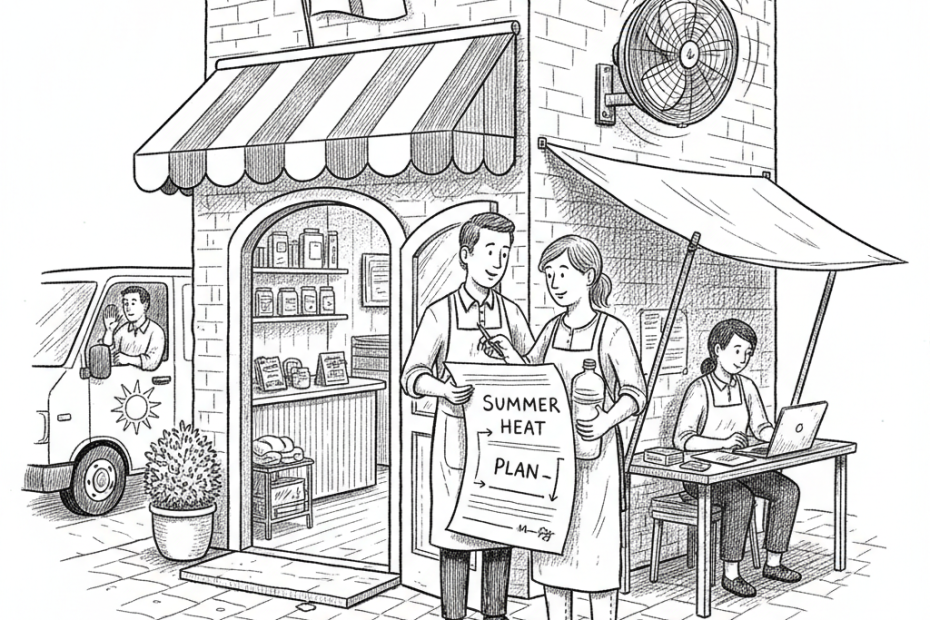
For small employers, the immediate job is not to overcomplicate the issue. Check the forecast and alert level, identify the hottest tasks and work areas, brief managers, make water and breaks easy, adjust schedules where practical, and watch staff who may be more vulnerable.
The current alerts run until Wednesday 27 May, but this is likely to be the start of a wider summer pattern rather than a one-off admin task. Firms that build a simple heat plan now will be better placed for later hot spells, with fewer rushed decisions when staff, customers and operations are already under pressure.
Sources: UKHSA: heat-health alerts across England; HSE: temperature in the workplace; GOV.UK: Beat the heat guidance.