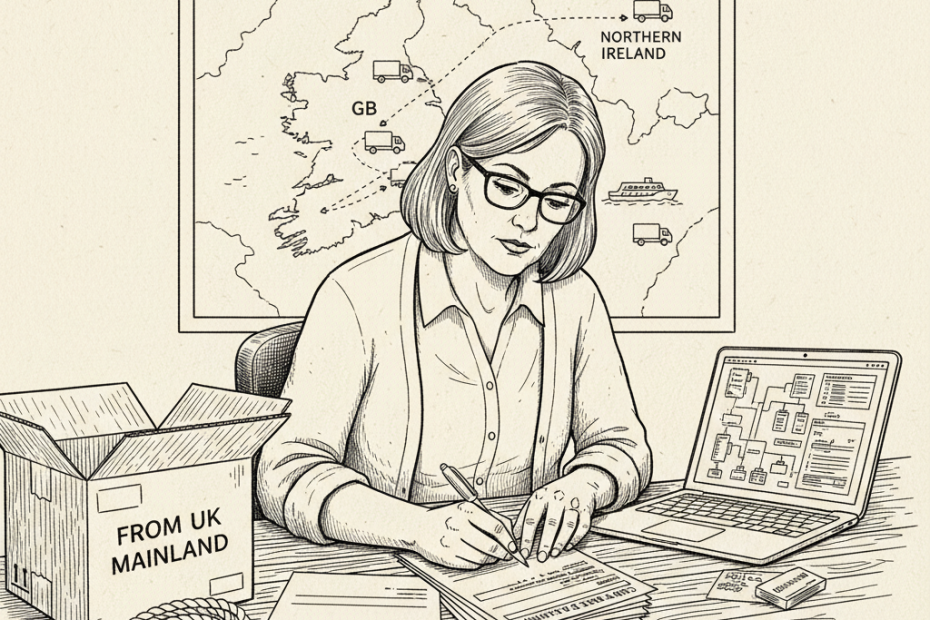
HMRC has updated its guidance on customs duty waivers for goods brought into Northern Ireland, adding another admin check for small firms that move stock from Great Britain or from outside the UK and EU.
The update matters because many smaller traders do not have in-house customs teams. A wholesaler, manufacturer, online seller, food supplier or local retailer can still face detailed rules if goods are treated as at risk of entering the EU market after arriving in Northern Ireland.
HMRC’s guidance says businesses may be able to claim a waiver so they do not have to pay duty on goods brought into Northern Ireland. The page was updated on 26 May 2026 with information about reclaiming state aid used to waive at-risk duties through the Duty Reimbursement Scheme, also described as a replenishment claim.
What has changed
The core point is not a brand-new customs scheme. It is a practical update to the guidance firms use when deciding whether they can claim a customs duty waiver and how previous aid affects their allowance.
HMRC says a waiver can apply to goods brought into Northern Ireland from Great Britain, or from countries outside the UK and EU. In the latter case, the waiver can cover the difference between the UK and EU tariff where goods would otherwise be charged at risk tariffs.
The guidance also reminds businesses that the waiver sits within de minimis state aid limits. That makes record keeping important. Firms need to understand not only the duty waiver they want to claim, but also other de minimis aid they have received, including aid that is not customs-related.
Why this matters for SMEs
For small firms, customs rules are rarely just a technical back-office issue. They affect landed cost, pricing, delivery promises, supplier relationships and cash flow.
A business moving goods into Northern Ireland may quote a customer, agree a wholesale order or set an ecommerce price before all the customs treatment is fully understood. If duty unexpectedly applies, the margin can disappear quickly. If paperwork is incomplete, the cost may be delay rather than duty, which can be just as damaging when a customer is waiting for stock.
The issue is especially relevant for firms that trade across both Great Britain and Northern Ireland, or that have grown from occasional shipments into regular movements. The admin that felt manageable at low volume can become a weakness once orders become routine.
BritishSME has previously covered how tax and compliance changes can force small firms to tighten their records. The same basic lesson applies here: the earlier a business captures the right information, the easier it is to avoid a rushed fix later.
The allowance check
HMRC says businesses can claim as part of a single undertaking. That can include a sole trader, company, partnership or a combination of businesses. Where more than one business is involved, the undertaking administrator manages the online account and reports relevant aid.
The standard allowance for businesses in the other sector is 300,000 euros over a rolling three-year period. The allowance is lower for some sectors: 50,000 euros over a rolling three-year period for agricultural primary production, and 30,000 euros over three tax years for fisheries and aquaculture.
That sector point should not be brushed over. HMRC says if a business in the undertaking is involved in more than one sector where a lower allowance applies, the lowest allowance applies to the whole undertaking. A mixed business therefore needs to be careful before assuming the broadest allowance is available.
The guidance also says claiming a waiver is a legal declaration that the claim will not push the business over its sector allowance. For smaller firms, that is a good reason to keep a simple internal log of customs duty waivers and other de minimis aid, rather than trying to reconstruct the position when a shipment is already moving.
What to check before claiming
HMRC says businesses need to subscribe to the online service before claiming. They may need an EORI number, a company email address, sign-in details and information about the businesses within the undertaking.
After subscribing, the undertaking needs to be registered and the business must select the relevant industry sector. HMRC says the service was updated in December 2025 to require undertakings to select a specific sector, and businesses that have not done so will be asked to when they next sign in.
For many SMEs, the practical checklist is straightforward: confirm the EORI position, check which businesses are in the undertaking, identify the sector, review de minimis aid already received, and decide who is responsible for maintaining the records.
That responsibility should not sit vaguely between finance, operations and whoever books the shipment. If goods movements are regular, one named person or adviser needs to understand the process well enough to spot when an order may need a customs check before it leaves the warehouse.
The practical takeaway
This update is a reminder that Northern Ireland goods movements can have real cost consequences for small firms, even where the business is not a large importer.
SMEs should not treat the customs duty waiver as a one-off formality. It depends on the nature of the goods, the route, the undertaking, sector limits and previous de minimis aid. If those records are scattered, a business may not know whether it can claim until too late.
The sensible move is to review the position before the next regular shipment. For firms that move goods into Northern Ireland, a short customs and aid allowance check now is easier than trying to fix a duty, pricing or delivery problem after the goods have already been declared.
Sources: GOV.UK: Check if you can claim a waiver for goods brought into Northern Ireland; GOV.UK: How to bring your goods into Northern Ireland from Great Britain without paying duty.