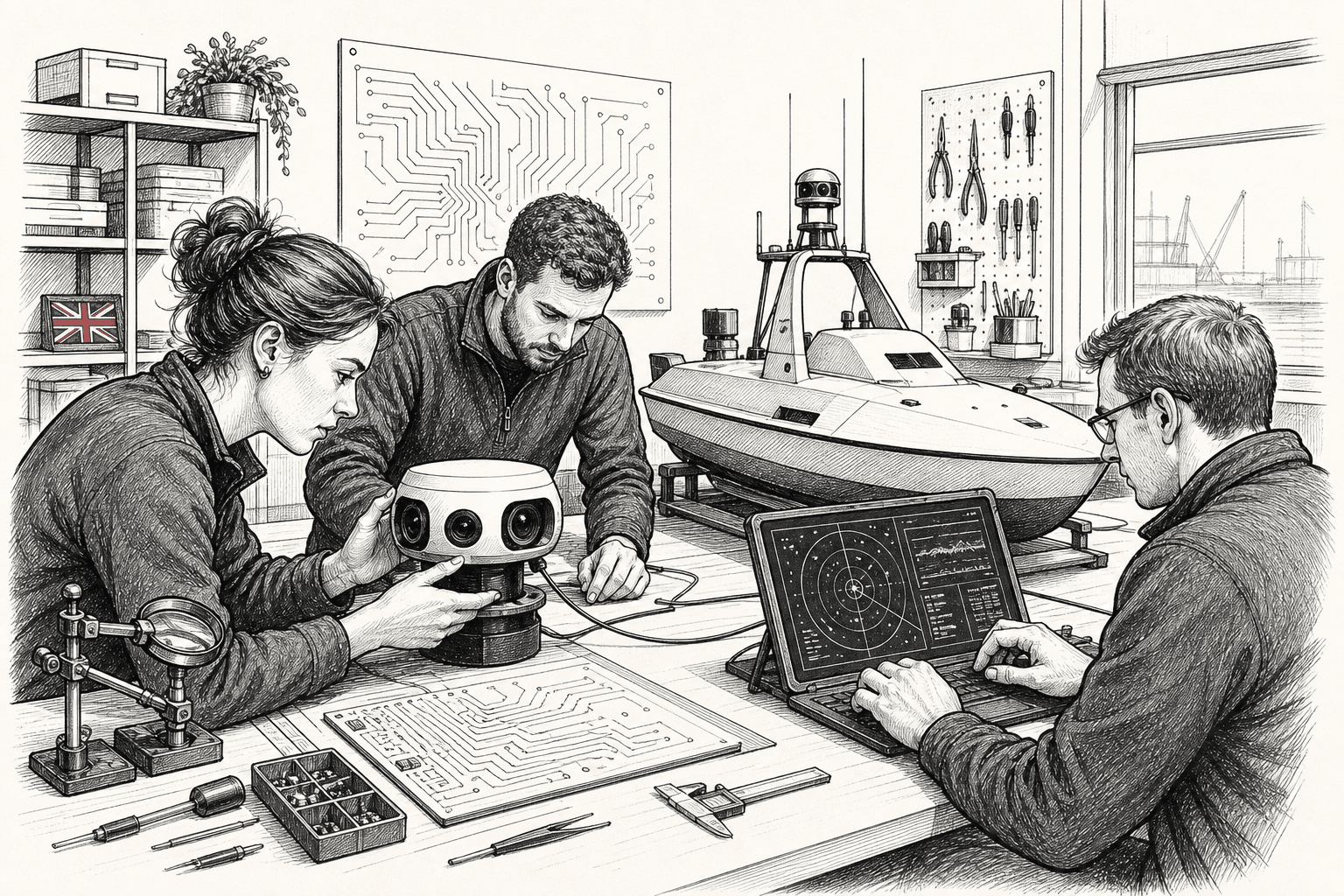
The latest AUKUS underwater technology announcement is not only a defence story. For specialist UK small businesses, it is another sign that advanced engineering, sensors, autonomy, software and systems integration are becoming a more active part of the defence growth agenda.
The Ministry of Defence said on 30 May that AUKUS partners will jointly develop technologies carried by uncrewed underwater vessels, with the first capabilities expected in service from 2027. It also named the winners of the 2025 AUKUS Maritime Innovation Challenge, including three British companies that will receive a share of GBP3 million to develop and test their capabilities.
That does not mean every small firm can suddenly sell into a complex defence programme. The route into defence can be slow, technical and compliance-heavy. But the announcement is still worth watching for SMEs already working in marine engineering, robotics, data, cyber, electronics, advanced manufacturing or specialist consultancy.
What has been announced
AUKUS is the security partnership between the UK, Australia and the United States. The better-known part of the programme is Australia’s move towards conventionally armed, nuclear-powered submarines. The latest announcement sits under Pillar 2, which is focused on advanced military capabilities.
According to the Ministry of Defence, the new project will develop payloads for uncrewed underwater vessels. These could include sensors and other systems that can be deployed across the three nations’ fleets. The government said the work is intended to strengthen underwater detection, support critical undersea infrastructure protection and create opportunities for UK industry.
The Maritime Innovation Challenge winners show why SMEs should pay attention. The UK-based winners include Decision Analysis Services Ltd, described by the government as an SME in Basingstoke, and A-2i, a micro-consultancy in Dorchester, Dorset. SEA Ltd, based in Frome, was also named among the UK winners. The challenge focused on command, control and teaming of undersea systems.
Why it matters for small firms
Defence supply chains are often seen as the preserve of primes and large manufacturers, but many of the capabilities now in demand are areas where smaller specialists can compete. Underwater autonomy needs sensors, modelling, communications, materials, testing, data handling, safety assurance and niche engineering know-how. Some of those strengths sit in small firms, university spinouts and consultancies rather than only in large contractors.
The practical message is not to chase every defence headline. It is to identify where a business has a genuine technical fit and then prepare for the standards, security expectations and partnership routes that defence customers require. Firms that can show a tested capability, clear documentation and a realistic path to scaling are more likely to be taken seriously.
BritishSME recently covered how Scotland’s defence growth deal could open doors for engineering SMEs. The AUKUS announcement points in a similar direction: public defence spending is increasingly being presented as an economic growth tool as well as a security measure.
What SMEs should check now
The first check is whether the business can describe its capability in defence-relevant terms. A firm may think of itself as a software, electronics, marine or analytics business, but defence buyers need to understand the operational problem being solved. A short capability statement should explain the technology, maturity level, evidence from trials or deployments, and the type of partner or customer it is suited to.
The second check is eligibility for innovation competitions and framework routes. Defence and security opportunities can appear through challenge funds, accelerator programmes, procurement portals and prime contractor supply-chain calls. Small firms should avoid waiting until a deadline is close before gathering insurance details, financial information, cyber credentials, quality documentation and case studies.
The third check is intellectual property and export control awareness. AUKUS is an international partnership, and underwater systems can involve sensitive technologies. SMEs do not need to become legal experts overnight, but they should know when to get specialist advice and should avoid sharing technical detail casually before commercial and security basics are understood.
Partnerships may matter more than going alone
For many small firms, the realistic route into a programme like this will be through collaboration. That could mean working with a larger defence contractor, joining a university-led project, teaming with a test facility, or supplying one specialist component into a broader system.
That makes relationship-building important. SMEs should keep track of the organisations already active in maritime autonomy, undersea infrastructure, defence innovation and regional growth programmes. A clear one-page capability summary and a concise technical deck can make those conversations easier.
Cash flow also deserves attention. Defence innovation funding can help, but payment timings, match-funding expectations and long sales cycles can still put pressure on smaller firms. Our coverage of late payment pressure on UK SMEs is a useful reminder that growth opportunities still need careful working-capital planning.
The practical takeaway
The AUKUS underwater technology announcement is a signal for specialist SMEs, not a guarantee of easy contracts. The strongest opportunity is likely to sit with firms that already have credible technical capability and can translate it into defence language, evidence and partnerships.
Engineering, software, sensor, autonomy and marine firms should use the announcement as a prompt to review their readiness: capability statement, technical proof points, cyber and quality basics, funding routes, and potential partners. The businesses that do that groundwork early will be better placed when the next challenge or supply-chain call appears.
Sources
- Ministry of Defence, Cutting-edge underwater tech for AUKUS forces to be developed through landmark partnership, 30 May 2026