
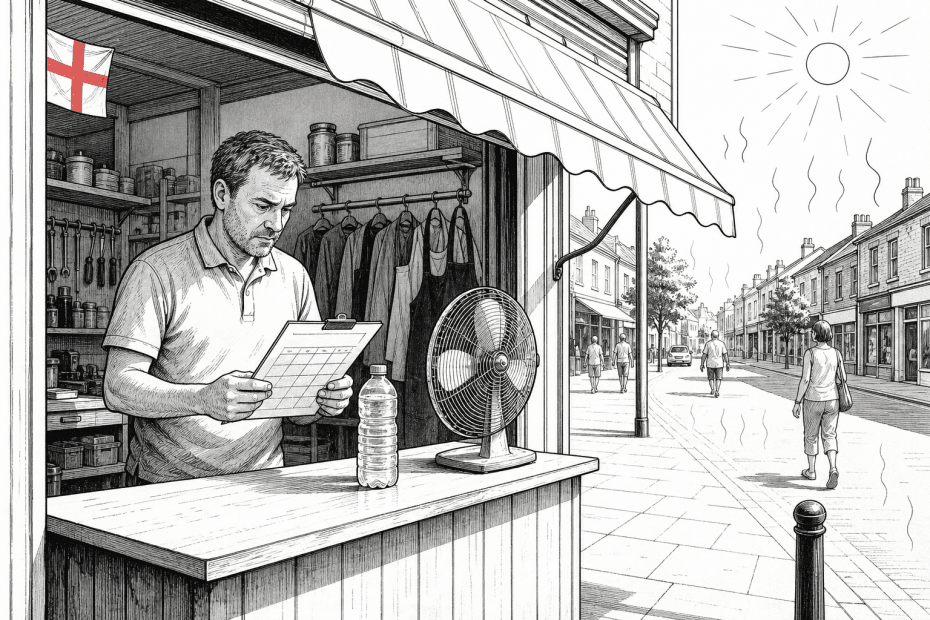
UKHSA has extended red heat-health alerts across parts of England, raising a practical issue for small employers as well as a public-health one. For shops, cafes, trades, clinics, workshops and local service firms, the question is not only whether staff can get through a hot day. It is whether the business has made sensible checks before conditions disrupt people, premises and customers.
The government update says red alerts are in place for the West Midlands, East Midlands, South East, South West, London and the East of England. UKHSA uses heat-health alerts to warn health and social-care services, local authorities and other organisations when temperatures may affect vulnerable people and wider services. A red alert is the highest level, so employers should treat it as a signal to review day-to-day operations rather than wait for problems to appear.
There is no single maximum workplace temperature in UK law, but employers still have a duty to provide a reasonable working environment and manage health and safety risks. In a heatwave, that can mean checking ventilation, shade, drinking water, rest breaks, manual work, lone working and travel between jobs. It also means thinking about staff who may be more vulnerable because of age, pregnancy, disability, medication, existing health conditions or heavy physical work.
For small firms, the fastest useful action is a short operational review. Ask which roles are exposed to the most heat, which premises are hardest to cool, and which tasks could be moved to cooler parts of the day. Outdoor work, deliveries, kitchens, stockrooms, vehicles, salons and workshops can all create different risks. A rota that worked in normal summer weather may not be the right rota during a red alert.
Customer-facing businesses should also think about service levels. Heat can change footfall, increase demand for some products, reduce dwell time, and make queues or waiting rooms uncomfortable. If staff are dealing with slower systems, late deliveries or anxious customers, clear opening updates and realistic appointment times may prevent avoidable friction.
Business travel is another area to check. Heat alerts often coincide with disruption risks on roads, rail and local services. Firms with mobile workers should confirm that jobs are still practical, that staff can reach sites safely, and that customers know if timings may move. For time-critical work, a simple priority list can help managers decide what must happen today and what can be delayed without letting clients down.
The earlier BritishSME guide on heat-health alerts for small employers set out the broader HR checks. This latest red alert makes those checks more urgent. It is worth recording any temporary changes too, so managers can explain decisions and reuse the same approach if further alerts follow later in the summer.
The practical takeaway is to keep the response proportionate but visible. Make sure staff know where to raise concerns, give managers permission to adjust tasks where needed, and check that basic controls are actually in place rather than assumed. In a small business, those steps can be the difference between a difficult hot spell and a preventable staffing, safety or service problem.
Source: UKHSA update on red heat-health alerts across England.


