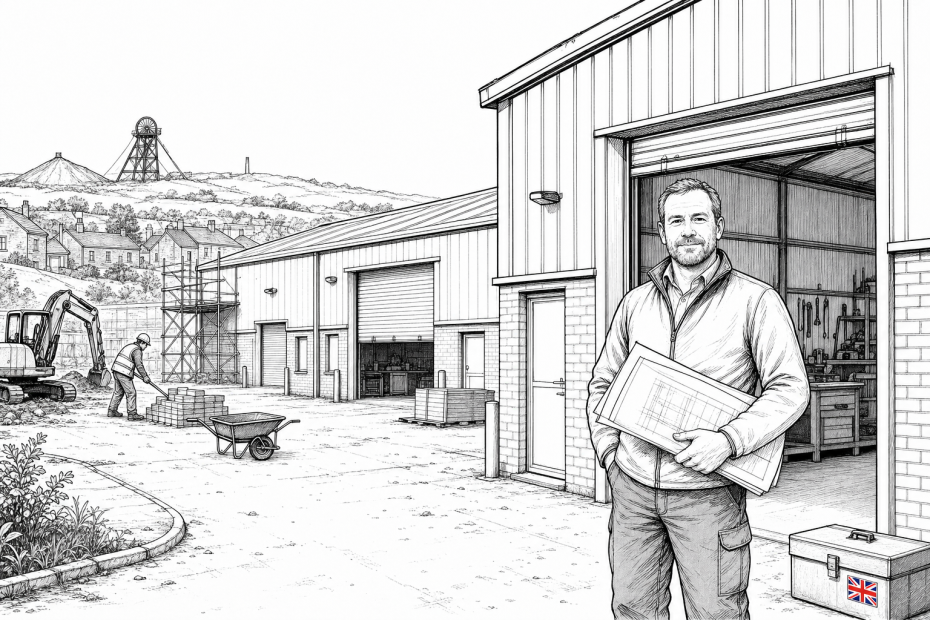
Six former coalfield areas are in line for new industrial workspace after the Treasury confirmed a £13.5 million funding package designed to bring more business space, jobs and local growth to communities that once depended on mining.
For small firms, the headline is not just another regeneration announcement. The useful point is more practical: new industrial developments can create room for workshops, light manufacturing, logistics, repair firms, trades, food producers and local service businesses that often struggle to find affordable, appropriate premises close to their workforce.
HM Treasury said on 19 June 2026 that former coalfield areas in England, Scotland and Wales will share the money to help construct new industrial developments for businesses. The locations named include Cowdenbeath in West Fife, St Helens in Merseyside and Seven Sisters in Neath Port Talbot, with six sites selected in total.
The funding will come from the government’s Growth Mission Fund and will cover half of the construction costs. The other half will be funded by the Coalfields Regeneration Trust, the charity focused on creating jobs and growth in coalfield communities. The Treasury says the projects are expected to create hundreds of new jobs and support thousands more.
That matters because suitable premises are a quiet constraint on many SMEs. A business may be ready to take on staff, add equipment or move out of a cramped unit, but expansion can stall if nearby space is too expensive, too large, too remote or simply unavailable. Regeneration schemes only help if they translate into usable units, realistic rents, decent access and the services small operators need.
Owners in and around the selected areas should treat the announcement as an early signal rather than an immediate property listing. The next useful step is to watch local council updates, Coalfields Regeneration Trust communications and commercial property notices for details on site plans, unit sizes, eligibility, timing and leasing terms.
There may also be opportunities for firms that do not need space themselves. Construction, maintenance, security, cleaning, transport, fit-out, professional services, training and recruitment businesses often benefit when new employment sites move from funding announcement to delivery. Local suppliers should keep an eye on procurement routes and main contractor appointments, especially if they can demonstrate local employment or apprenticeships.
For employers, the skills angle is just as important as the buildings. Former coalfield communities often have strong labour market links to practical trades, engineering, manufacturing, transport and site-based work. If the new developments succeed, the benefit should be more than square footage: it should help firms recruit locally, shorten commutes and give young people a clearer route into work close to home.
There are some sensible cautions. Public funding does not guarantee that every unit will be priced for smaller firms, and regeneration projects can take time to move through planning, procurement and construction. Businesses should not make financial commitments until detailed terms are available. They should, however, prepare the basics now: what space they would need, what rent level is viable, what equipment or power requirements matter, and whether extra staff would be needed if a move became possible.
The wider SME takeaway is that place-based investment is most useful when small firms engage early. Local chambers, business groups and councils can help shape practical questions about access, broadband, parking, loading, energy supply and public transport. Those details are often the difference between a business park that looks good on paper and one that actually works for day-to-day operators.
Small businesses in nearby coalfield communities should therefore watch this funding closely, but with a business plan in hand. If the developments create the right kind of affordable workspace, they could become a route to expansion for firms that have outgrown home offices, high street back rooms or ageing industrial units.
Source: HM Treasury announcement on coalfield area investment.