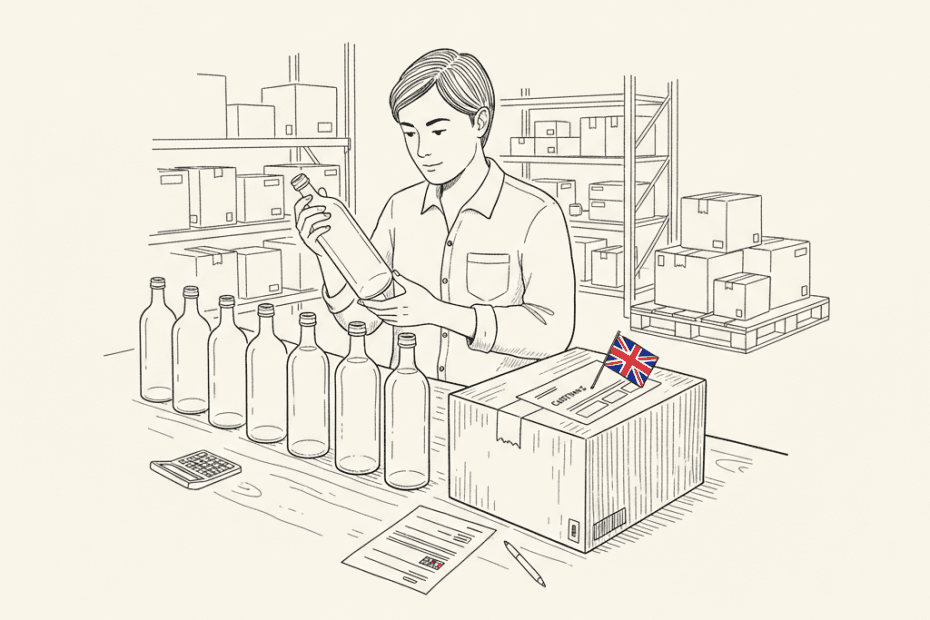
UK businesses that import glass bottles and jars from China face a new cost and cash-flow issue from today. The Government has accepted a Trade Remedies Authority recommendation for provisional anti-dumping measures, with tariffs of up to 53% on certain Chinese glass containers from 9 September 2026.
The measure matters beyond the glass industry itself. Bottles, jars, pots, flasks and phials are widely used by smaller food and drink producers, cosmetics brands, fragrance businesses and other manufacturers. Firms that import the affected goods directly may now have to provide a financial guarantee for the estimated duty. Businesses buying through UK packaging suppliers could also see prices, lead times or product choices change as the supply chain adjusts.
What has changed
The Trade Remedies Authority opened its investigation in March and says it has found preliminary evidence that the goods concerned were being sold in the UK below their normal value, causing injury to British producers through undercutting and price suppression. The investigation is continuing, so this is a provisional measure rather than the final outcome.
Under the Government’s decision, affected importers must give a guarantee covering the estimated anti-dumping duty. Depending on the exporter and product, the tariff can be as high as 53%. The provisional arrangement is expected to apply for six months from 9 September, or until a definitive measure is introduced if that happens sooner.
The UK glass container sector is economically significant. According to the Trade Remedies Authority, the producers sampled in its investigation employ about 2,099 people and generate £244 million in gross value added. The measure is intended to protect that industry while the authority completes its work.
Which SMEs should pay attention
The immediate compliance obligation falls on importers of goods covered by the official trade remedies notice. Small firms that source bottles or jars from China should therefore check commodity codes, origin evidence and supplier details with their customs agent or freight forwarder before the next shipment is cleared. The scope is product-specific, so businesses should use the notice itself rather than assume that every glass item is covered.
Even firms that do not import directly should review their exposure. Craft drinks makers, preserves producers, beauty brands and contract packers often buy containers from distributors. Those suppliers may change quotes or terms if replacement stock costs more or if guarantees tie up working capital.
This does not automatically mean every UK-made container will become more expensive. Domestic producers may benefit from relief against imports that the authority believes were unfairly priced. Buyers could also respond by changing container formats, sourcing from other countries or agreeing longer-term contracts. However, SMEs should allow for short-term uncertainty while importers and suppliers assess the notice.
What small businesses can do now
First, identify any orders that are already in transit or due to clear customs soon. Ask the importer of record whether the shipment falls within the notice and whether a guarantee will be required. Firms should also establish who is contractually responsible for any additional duty or customs cost rather than discovering that after delivery.
Second, request updated written quotes from packaging suppliers. Check how long prices remain valid, whether minimum order quantities have changed, and whether substitute containers are genuinely compatible with filling lines, caps, labels and transport packaging. A cheaper alternative can create larger costs if it requires production changes or increases breakage.
Third, revisit cash-flow forecasts. A guarantee, higher deposit or more expensive shipment can use working capital before finished goods are sold. Businesses with seasonal production should model the impact across the full ordering cycle and consider whether purchases can be staged without risking shortages.
Finally, keep records of the product specification, origin, exporter and customs advice used for each decision. The investigation is still open and the final position may change. Interested parties can respond through the Trade Remedies Service public case file, while importers should monitor the official notice for amendments.
The practical takeaway
For UK SMEs, the key issue is not the headline tariff alone. It is whether a packaging order falls within scope, who carries the extra cost, and how quickly suppliers can offer alternatives. A prompt check with customs and packaging partners can turn a surprise at the border into a manageable purchasing decision.
Businesses should avoid making assumptions based on a general product description. Confirm the precise treatment of planned imports, build some flexibility into packaging budgets and keep watching the investigation. The provisional measure begins today, so firms with near-term orders have little reason to wait.
Sources
Sources: Trade Remedies Authority announcement; official trade remedies notices for certain glass containers from China; TRA provisional determination and guarantee recommendation.