
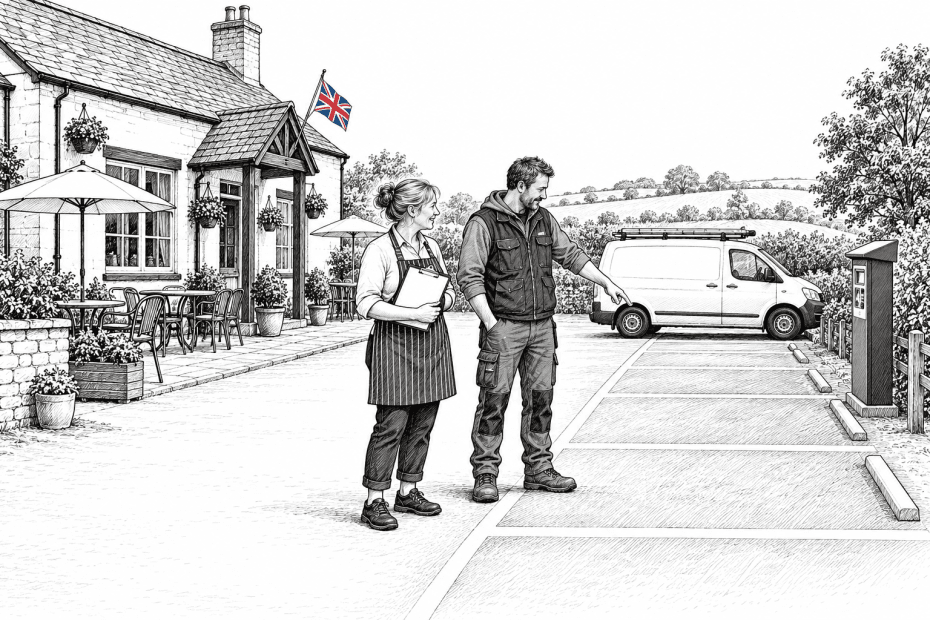
Small firms with customer car parks, and businesses whose staff drive between jobs, have a new parking-code announcement to watch. The government has set out protections intended to make private parking charges fairer. For a shop, cafe or trades business, this is a useful moment to review parking instructions and how problems reach the right person.
What the government has announced
The government announcement describes a five-minute period to decide whether to park and ten minutes to leave after a session ends. It says the new Code will cover England, Scotland and Wales.
Specified circumstances, including breakdowns, medical emergencies and broken ticket machines, would allow charges to be cancelled on appeal with supporting evidence. Certain smaller mistakes, such as forgetting a permit or entering the wrong vehicle registration, would attract a maximum £20 charge on appeal. The maximum parking charge would remain £100.
Parliament will scrutinise the Code before ministers bring it into force. The announcement gives no commencement date, so businesses should prepare rather than assume these protections already govern every current ticket. A further consultation on debt-recovery fees is planned for next year; those fees have not been abolished by this announcement.
Check the experience outside your premises
If customers use a private car park connected to your business, walk through the process as a first-time visitor. Can someone arriving for an appointment tell where to park, whether payment is needed and whether they must enter their registration inside? Check the wording in booking confirmations against the instructions at the site.
Make the same check for temporary arrangements. A replacement vehicle, visiting contractor or customer staying longer than expected can expose gaps in a process that works for regular visitors. Ask staff how they explain parking, and give them one clear contact for questions they cannot resolve.
Where a landlord or outside operator manages the site, ask for its implementation plan once the final timetable is available. Useful questions include how entry and exit times are handled, what happens when equipment fails, and how a customer can submit evidence. Confirm who can investigate a complaint before promising a visitor that your business can cancel a charge.
Keep a simple record of recurring problems and the dates you reported them. Several customers describing the same confusing instruction is a reason to raise the issue with the site manager. These are practical service checks a business can make now, without guessing at the final transition arrangements.
Give work drivers a clear reporting route
For firms sending staff to customer sites, add parking arrangements to the job notes: the correct entrance, the relevant vehicle registration and any visitor-registration step. Include a contact who can confirm the arrangements if the usual space is unavailable. Parking information belongs alongside the route and site-access planning that helps deliveries run smoothly.
Ask drivers to report a disputed charge promptly and retain the notice, payment record and relevant photographs. A dated account of a failed machine or breakdown is more useful than trying to reconstruct events weeks later. Make sure someone checks the response instructions, particularly when correspondence first reaches an office rather than the driver.
Use the correct challenge process
Some appeal protections already exist under the industry code. The CMA’s July advice explains that evidence can support cancellation or a reduced charge in specified circumstances. Drivers should check the rules at each site and avoid assuming that customer parking is automatically free.
For an existing ticket, start with the issuer and the procedure on the notice. GOV.UK’s current challenge guidance separates private-company tickets from council penalty notices. For private parking, it directs motorists to the operator first, then to the relevant independent appeals service if the challenge is rejected: POPLA for British Parking Association members or IAS for International Parking Community members.
The useful action today is straightforward: make parking instructions clear, preserve evidence and keep track of correspondence. Check the final Code and implementation timetable before changing policies around the newly announced protections.
Sources: Government parking-code announcement; GOV.UK ticket-challenge guidance; CMA parking advice; 2025 consultation background.