Small firms that spend money on client hospitality, staff events or business development meetings have a fresh reason to check how they are treating VAT. HMRC has updated its Business Entertainment VAT Notice to clarify who counts as an employee, and who does not, when applying the business entertainment rules.
The change is not a new marketing opportunity or a headline tax cut. It is more useful than that: a practical reminder that meals, events, tickets and hospitality can be treated very differently depending on who attends, why the cost was incurred, and whether the person being entertained is an employee, a customer or another business contact.
For SMEs, especially those without an in-house tax team, this is the kind of detail that can quietly affect VAT returns, bookkeeping processes and the way expenses are approved. It is also the kind of issue that can become messy later if receipts are filed without enough context.
What HMRC has updated
HMRC says the Business Entertainment VAT Notice was last updated on 3 June 2026. The update to the business entertainment section confirms which people are, and are not, treated as employees for the purpose of the rules.
The notice explains that VAT on business entertainment provided to UK business contacts, and to non-UK business contacts who are not customers, is normally blocked from recovery. In simple terms, a business may not be able to reclaim the VAT on hospitality given free to people outside the business, even when there is a commercial reason for the meeting or relationship.
HMRC gives examples of entertainment that can fall within the rules, including food and drink, accommodation, theatre or concert tickets, sporting events, club entry, and the use of assets such as yachts or aircraft for entertaining. For most small firms, the more everyday examples will be meals, drinks, event tickets, trade hospitality and customer-facing networking costs.
Why the employee distinction matters
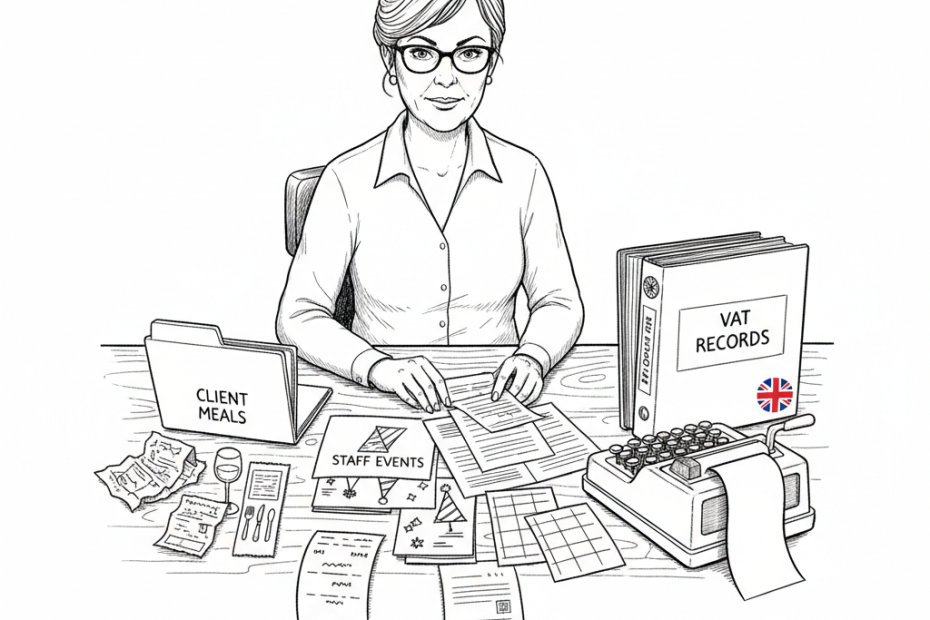
The employee point matters because staff entertainment and business entertainment are not the same thing for VAT purposes. HMRC says entertainment provided for employees, such as staff parties, team-building exercises or outings intended to reward employees or support morale, is generally treated as being for business purposes.
But the notice also sets out important limits. If entertainment is provided only for directors, partners or sole proprietors, HMRC says the VAT cannot be recovered because the goods or services are not being used for a business purpose. Where directors or partners attend a wider staff party with other employees, HMRC accepts that the VAT is input tax and is not blocked under the business entertainment rules.
The updated notice also makes clear that not everyone connected to a business is treated as an employee for these purposes. Former employees, pensioners, job applicants, interviewees and shareholders who are not also employees are listed separately from employees.
That distinction can be easy to miss in a small company where relationships overlap. A shareholder may be a founder, a former worker may still be close to the business, and a job candidate may be hosted as part of a recruitment process. For VAT records, the label on the expense needs to match the tax treatment, not just the informal relationship.
Customer hospitality still needs care
HMRC’s notice also underlines that ordinary customer hospitality is a sensitive area. It says basic refreshments, such as sandwiches and soft drinks provided in the office during a meeting so the meeting can continue, may not create the same issue as more generous hospitality after the meeting.
By contrast, taking a customer to a restaurant is very likely to create a private use charge where VAT is recovered, according to the notice. Hospitality involving alcohol, or hospitality provided because it is polite, expected or relationship-building, is unlikely to meet the strict business purpose test HMRC describes.
There is also a separate rule for overseas customers. HMRC says VAT incurred on entertaining overseas customers may be recoverable where the cost is for the purpose of the business and is reasonable in scale and character, but an output tax charge may arise if there is private benefit to the person receiving the hospitality.
What small firms should check now
Owner-managed companies, agencies, consultancies, hospitality operators, sales-led businesses and professional services firms should use the update as a prompt to review how entertainment expenses are coded. That does not need to mean a major project, but it should mean looking at the expense categories staff use, the notes required on receipts, and the split between employee, customer and mixed events.
A sensible first step is to make sure expense claims record who attended, their relationship to the business, the purpose of the event, and whether any non-employees were hosted by employees. Where an event mixes staff and non-staff, the business may need to apportion the VAT rather than treat the full cost in one way.
SMEs already preparing for wider HMRC compliance changes may also want to connect this with their digital record-keeping habits. BritishSME has previously covered Making Tax Digital for Income Tax and the need for cleaner records; the same discipline helps with VAT evidence, even where the specific rules are different.
The practical takeaway is straightforward: do not treat every lunch, ticket or staff event as the same kind of VAT expense. HMRC’s updated notice gives small firms a useful moment to tighten their categories before the next VAT return, especially where directors, shareholders, job candidates, customers and employees may all appear in the same expense system.