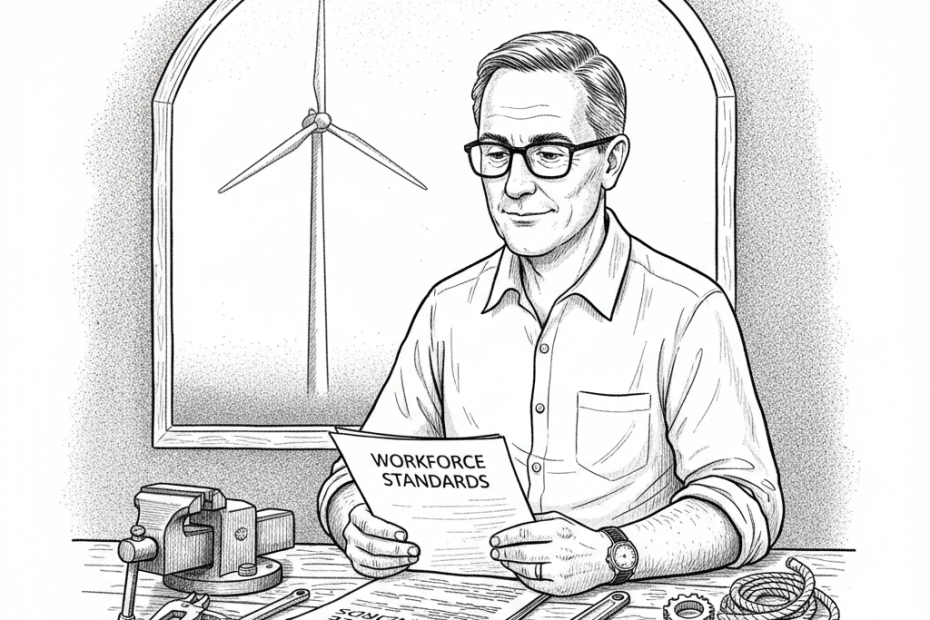
The government has announced that an initial group of offshore wind supply chain companies and trade unions has backed its Offshore Wind Fair Work Charter, setting out stronger expectations on worker voice, health and safety, fair terms, apprenticeships and inclusive workplaces.
For small businesses, the announcement is not only a labour-relations story for large energy firms. It is a sign that workforce standards may become more visible across clean energy supply chains, especially for engineering, port services, marine support, fabrication, civils, logistics and specialist contractors hoping to work around offshore wind projects.
The Department for Energy Security and Net Zero said 37 supply chain companies had agreed to sign up to the charter, alongside trade unions including GMB, RMT, Prospect, the TUC, UNISON and Unite. The list includes ports, manufacturers, cable specialists, engineering firms and infrastructure contractors.
The practical point for SMEs is simple: if clean energy is part of the growth plan, employment standards, skills plans and evidence of good workforce practice may matter more in future tenders and commercial conversations.
What has changed
The charter is intended to give unions better access to workplaces and opportunities to speak directly to staff, alongside stronger workplace standards on health and safety. The government also said future agreements between offshore wind companies and trade unions are expected to include commitments on fair terms and conditions, apprenticeships and more inclusive workplaces.
That does not mean every small supplier now faces a new immediate legal duty from this announcement. But it does add to a broader direction of travel. Major customers and tier-one contractors increasingly want to show that their supply chains are resilient, skilled and responsible. SMEs that can demonstrate those things clearly may be better placed than firms that treat workforce evidence as an afterthought.
This is especially relevant in parts of the country where clean energy investment overlaps with local manufacturing, port activity and engineering skills. BritishSME has previously covered how regional growth deals can open doors for engineering SMEs. The same lesson applies here: public policy and large industrial programmes can create openings, but smaller firms still need to be ready for the standards that come with them.
Why SME suppliers should pay attention
Many small firms enter large supply chains through narrow, practical roles: maintenance, fabrication, transport, training, safety support, professional services or specialist technical work. Winning that work is often about price, availability and competence. But buyers may also ask more questions about workforce management, insurance, training, accident reporting, subcontracting and how the business treats employees.
For a small employer, those questions can feel burdensome. They are also a chance to stand out. A business that keeps clean records on training, apprenticeships, safety checks, staff consultation and employment terms can respond faster when a tender or framework opportunity appears.
The charter also connects to a wider skills challenge. Offshore wind and related infrastructure need people who can work safely in technical environments. Small businesses that already train apprentices, support younger workers or cross-train existing staff should make sure that story is visible in capability statements and supplier applications.
What to check now
SME owners do not need to overreact to a single announcement. A useful first step is to review whether existing people policies and safety records would stand up to a larger customer’s due diligence. That includes contracts, working hours records, health and safety training, incident logs, right-to-work checks, apprentice supervision and evidence that managers deal with workplace concerns properly.
Firms should also look at how they describe their workforce strengths. If the business has low staff turnover, good training, local hiring links, specialist certifications or apprenticeship experience, those points should not be buried. They can help a buyer see the firm as a reliable supply chain partner rather than just a low-cost subcontractor.
Cash flow remains part of the picture too. Large supply chains can bring bigger opportunities, but they can also expose SMEs to slow onboarding, longer payment terms and higher compliance costs. Owners should understand the working capital impact before taking on a contract that requires extra staff, equipment or certification. Our earlier coverage of late payments and SME cash flow is relevant whenever a small firm is weighing larger customer work.
The takeaway
The Offshore Wind Fair Work Charter is aimed at improving standards in a fast-growing sector. For SMEs, the opportunity is to treat it as an early prompt rather than a distant policy story.
If your business supplies, or wants to supply, clean energy projects, now is a good time to tidy workforce records, strengthen training evidence and make sure employment standards are part of your commercial pitch. In a market where larger buyers need confidence in their supply chains, that preparation could be as important as technical capability.
Source: GOV.UK announcement on the Offshore Wind Fair Work Charter.