
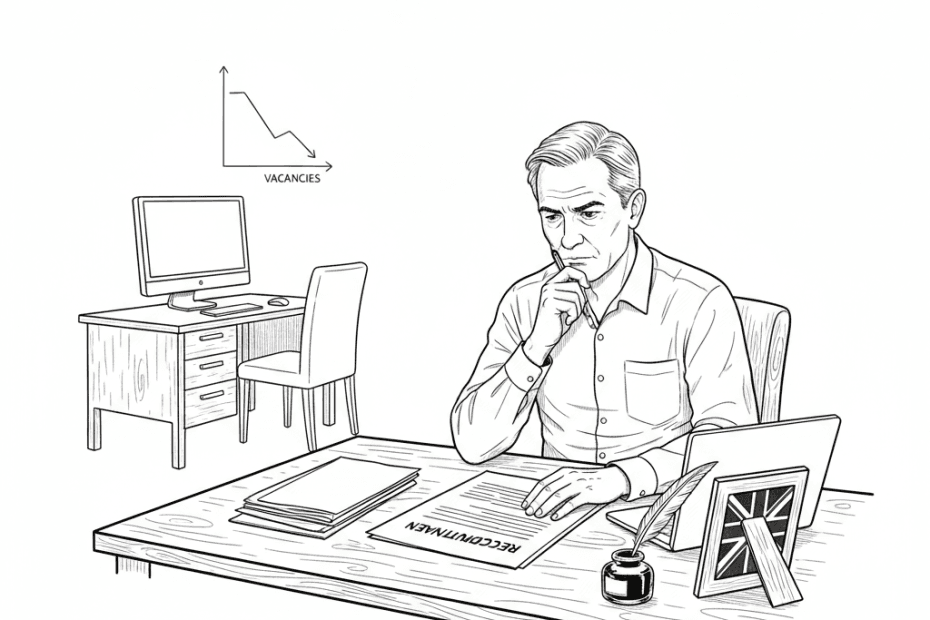
UK job vacancies have fallen to their lowest level in more than five years, with smaller businesses pulling back from recruitment as employment and operating costs weigh on hiring decisions. For SMEs, the figures are a warning about confidence and costs—but they may also create an opportunity to recruit carefully in parts of the market where competition for candidates has eased.
What the latest figures show
The number of vacancies declined to 707,000 in the May-to-July period, according to Office for National Statistics figures reported by the BBC. The ONS described the labour market as little changed overall, while unemployment remained at 4.9%.
The detail matters for smaller employers. The ONS said small firms were reporting labour and operating costs as reasons for reducing recruitment. Businesses have faced higher employment costs, including increases in National Insurance and the minimum wage, while energy and other overheads remain a concern.
Regular earnings excluding bonuses grew by 3.5% over the year in the three months to June. That headline masks a marked split: public-sector regular pay rose by 6.1%, influenced by the timing of NHS pay awards, while private-sector growth eased to 2.8%.
The result is a low-movement labour market. Employers may be reluctant to add permanent cost when demand is uncertain, but employees may also be less willing to change jobs. A lower national vacancy count does not automatically mean every small business will find its required skills easily.
Why this matters to SMEs
For a small employer, each hire carries proportionally more risk than it does for a large organisation. Salary is only one part of the calculation. Employer National Insurance, pension contributions, equipment, software, management time, training and the cost of a poor hiring decision all affect the real budget.
Delaying every vacancy can carry costs too. Persistent gaps can leave owners doing operational work instead of winning customers, increase pressure on existing staff and slow delivery. The useful question is therefore not simply whether to hire, but which capability the business cannot afford to leave uncovered.
A softer market may give employers more applicants and slightly more time to make decisions. However, skilled candidates in areas such as technology, engineering, finance and specialist trades can remain scarce even when vacancies fall overall. SMEs still need a clear role, a credible offer and a recruitment process that respects applicants’ time.
Four practical checks before recruiting
1. Rebuild the full employment-cost calculation. Start with the proposed salary, then add employer taxes, pension costs, benefits, recruitment fees, equipment and realistic onboarding time. Compare that annual cost with the revenue protected, capacity created or risk reduced by the role.
2. Define the result, not a wish list. Identify the three or four outcomes needed during the first six months. This can prevent an SME from advertising an unrealistically broad “all-rounder” role and helps candidates understand how success will be judged.
3. Test alternatives without disguising employment. Training an existing employee, improving a process, changing hours or using genuine specialist support may solve a short-term problem. Businesses should still classify working arrangements correctly and avoid treating a role as freelance merely to reduce costs.
4. Protect retention. If recruitment is paused, explain priorities to the team and monitor workloads. Saving the cost of one vacancy can be a false economy if experienced employees burn out or leave. Flexibility, development and better job design may be as important as headline pay.
What to watch next
SME owners should watch vacancy trends alongside customer demand, wage movements and interest-rate decisions rather than treating one release as a forecast. Analysts cited by the BBC said contained underlying wage pressure gave the Bank of England little reason to change course in September, although individual businesses will still face very different financing and cost pressures.
The immediate takeaway is to make hiring more deliberate. Keep a simple workforce plan covering essential roles, likely trigger points and the full cost of recruitment. That gives a business a basis for acting when demand improves—and reduces the chance of making a rushed hire after capacity has already become a problem.