England-based small businesses with enough land or yard space may soon have a simpler route to generating some of their own electricity. The government has opened a consultation on new planning rules that would let non-domestic sites install one small onshore wind turbine without making a full planning application, provided certain conditions are met.
That will not help every SME. Many firms will not have the right site, budget or electricity demand to make a turbine stack up. But for some farms, workshops, factories and other energy-hungry premises, the proposal matters because it could cut delay, cost and uncertainty at the point where a good project often falls apart.
The announcement is aimed at England, and the government says the proposed change would apply to businesses, farms and public sector organisations rather than households. In practice, it is one of those policy shifts that may sound niche at first glance, but could be genuinely useful for smaller employers facing stubborn energy costs and trying to make their sites more resilient.
What is being proposed
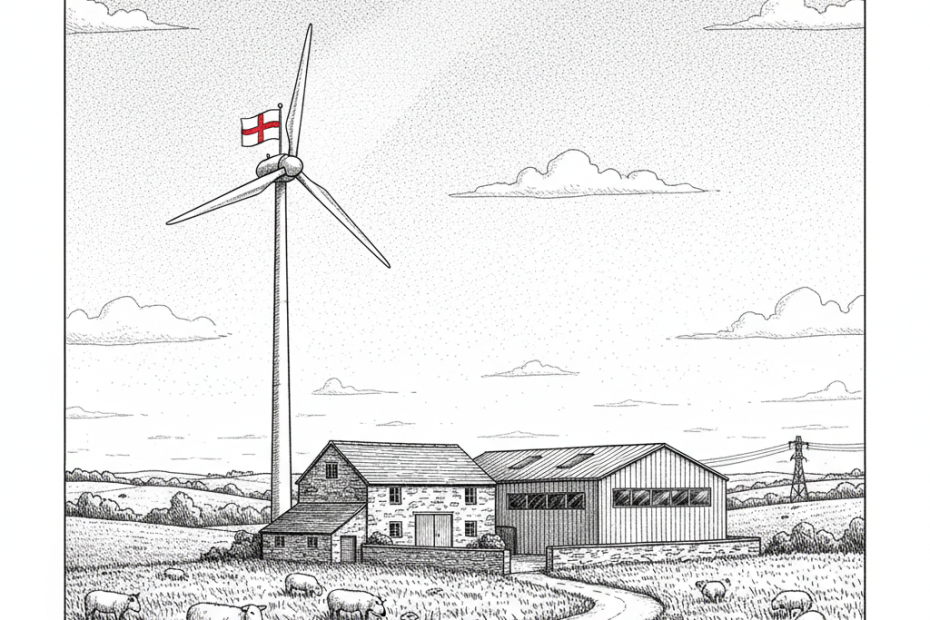
Under the consultation published on 18 March, the government is considering a new permitted development right for a single standalone wind turbine on non-domestic premises in England. The headline idea is simple: if a project fits within the rules, the owner would not need to go through a standard planning application.
The government’s accompanying announcement says the turbine could be up to 30 metres high, which it describes as roughly the height of an oak tree. The consultation also makes clear this is not a blanket green light. The proposed right would still come with conditions and limitations, and the policy is designed for lower-impact small-scale projects rather than large commercial wind developments.
Some protected locations would remain out of scope, and the consultation asks for views on how the safeguards should work. So this is not an immediate rule change. It is a live proposal, and the details still matter.
Why this matters for SMEs
For the right business, the issue is not only climate policy. It is cost control. Electricity remains a major pressure point for many smaller operators, especially firms with machinery, refrigeration, long opening hours or other heavy on-site usage.
That includes farms with workshops or storage buildings, manufacturers and fabricators, food producers, rural hospitality venues and some schools or community organisations that also buy from local suppliers. When power prices are volatile, even partial on-site generation can look more attractive than it did a few years ago.
The catch has been friction. A small project can make sense on paper and still die because the planning route is too slow, too uncertain or too expensive relative to the likely savings. That is the barrier the government says it wants to reduce.
It also fits a broader pattern in which smaller firms are being pushed to think harder about operational resilience. We have seen the same theme in stories about fuel costs, cyber risk and weak demand. A business that can bring down a fixed overhead, even modestly, may feel more able to invest elsewhere or ride out quieter trading periods, much as firms are already being urged to watch wider trading conditions in the UK economy flat in January update.
What business owners should keep in mind
First, this is England-only and still at consultation stage. No business should assume the policy is final, or start spending on the basis that planning permission will definitely not be needed.
Second, suitability will be highly site-specific. A turbine that works for a farm, yard or light industrial site may be unrealistic for a town-centre premises, a tightly packed estate or anywhere with awkward neighbouring uses. Grid connection, wind resource, access, noise considerations, financing and payback still matter.
Third, even if the planning route becomes easier, this will not replace the need for a proper commercial decision. SMEs will still need to weigh installation costs against likely savings, maintenance and how long they expect to remain at the site.
For some firms, other energy-saving support may still be the more practical first step. Hospitality businesses, for example, may get more immediate value from simpler efficiency upgrades or existing tools, including the free support covered in our recent piece on the energy-saving tool for England’s hospitality SMEs.
The practical takeaway
This is not a mass-market answer to high business energy bills, but it could become a useful new option for a specific slice of England’s smaller employers: those with the right land, the right energy profile and the appetite to invest in on-site generation.
If your business is farm-based, semi-rural or runs from a larger workshop or factory-style site, this is a consultation worth noticing. The main opportunity is not only cheaper power. It is the chance to remove one more layer of delay from a project that could improve long-term cost stability.
Sources
- Department for Energy Security and Net Zero, Lower bills for farmers, schools and factories, published 18 March 2026
- Department for Energy Security and Net Zero, Permitted development rights for onshore wind turbines in England, consultation published 18 March 2026