
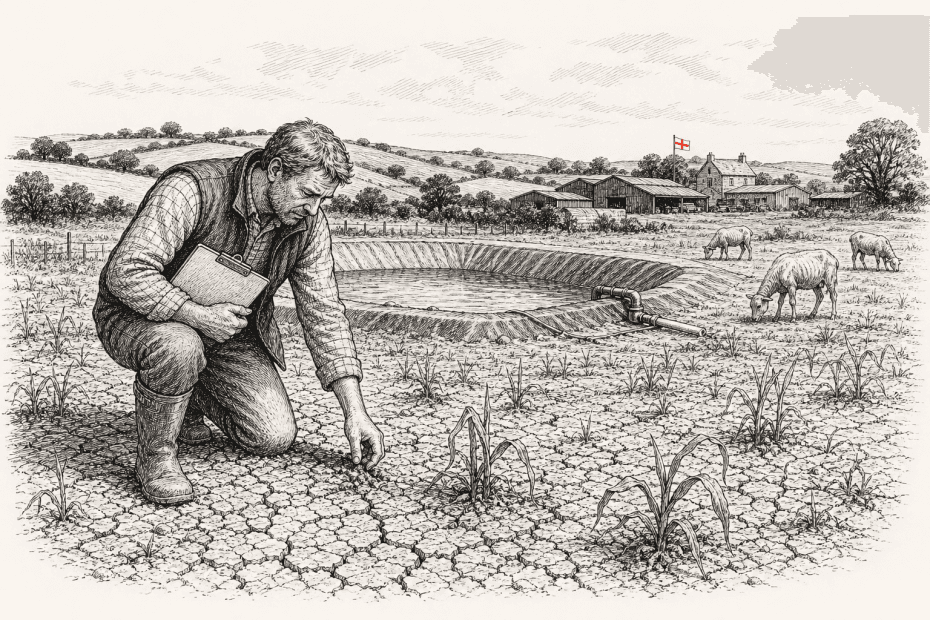
Farm businesses across England are set to receive a £65 million support package as prolonged dry weather puts pressure on crops, livestock feed and water supplies.
The government announced the measures on 14 August after what it described as the driest July on record in England and Wales. For small farms and rural businesses, the important point is that the package combines immediate flexibility with funding intended to improve longer-term water resilience.
What has been announced?
The package includes an extra £50 million for the Sustainable Farming Incentive (SFI) in 2026, taking its total budget to £290 million. A further sum of up to £15 million will support on-farm reservoirs, helping businesses store water for future dry periods.
Farmers affected by drought will also be given more flexibility under environmental land-management agreements. Where grass has failed, some land normally reserved for habitat management may be used to feed livestock without the farmer automatically losing scheme payments, provided the soil is not damaged.
The government says it will simplify arrangements for accessing and sharing water during drought conditions. Existing environmental limits remain in force, including restrictions designed to protect rivers when flows are low, but the administration of licence variations and water-sharing between holdings is expected to become easier.
Planning barriers for farm reservoirs are also under review. Updated national planning guidance is due to provide more detail, alongside an evidence-led review of permitted development rights for on-farm reservoirs.
Why this matters to small farm businesses
Dry weather can create several costs at once. Lower yields reduce income, while farms may need to buy additional feed, transport water or change harvesting plans. Restrictions on abstraction can add another operational constraint just when water demand is highest.
The pressure is widespread. According to the announcement, around three-quarters of England is currently in drought, and the Environment Agency recorded more than 1,500 abstraction licence restrictions in the week to 12 August. Section 57 spray-irrigation restrictions applied to 302 licences in East Anglia alone.
For firms elsewhere in the rural supply chain, the effects can travel quickly. Agricultural contractors, food processors, hauliers and hospitality businesses that buy locally may all face changes in volumes, timings or prices. The government says national food security is not expected to be affected, but individual businesses may still experience significant disruption.
What farm owners should check now
Businesses should first confirm whether their area and water arrangements are affected by current drought restrictions. An abstraction licence does not guarantee that water can always be taken, so operating plans should reflect any hands-off flow conditions or temporary restrictions.
Farmers participating in SFI, Countryside Stewardship or legacy stewardship agreements should check the exact drought flexibility available before changing how agreement land is used. The announcement offers reassurance that practical changes may be permitted, but record-keeping remains important. Note the condition of the land, why a change was necessary and any steps taken to avoid soil damage.
It is also worth reviewing short-term cash flow under several yield and feed-cost scenarios. Speak early to customers, suppliers and lenders if delivery volumes or payment timings may change. Small businesses should avoid assuming that headline funding will arrive immediately or that every holding will qualify on the same terms.
Finally, farms considering water storage should begin gathering evidence about current water use, lost output and likely future need. Details of the reservoir funding and revised planning position will determine whether a project is practical, but early preparation can make it easier to respond when application guidance opens.
What to watch next
The key unanswered questions are how the £15 million reservoir support will be allocated, when applications will open and what costs will qualify. Businesses should also watch for the updated National Planning Policy Framework and further guidance from Defra, the Rural Payments Agency and the Environment Agency.
The measures apply to England only because farming policy is devolved. Businesses in Scotland, Wales and Northern Ireland should follow guidance from their respective administrations.
Source
UK government: support for farmers affected by drought, published 14 August 2026.