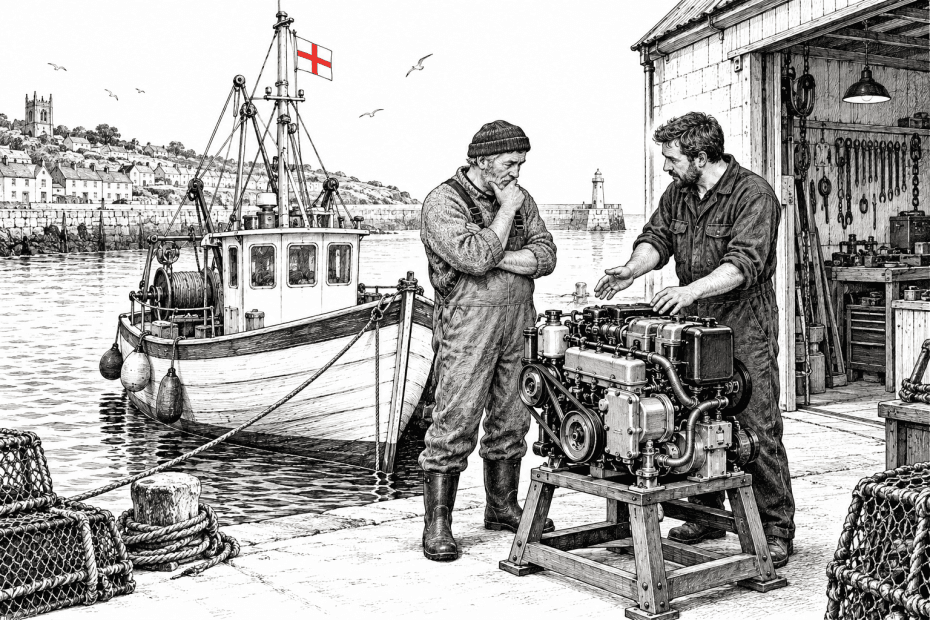
Fishing businesses in England planning an engine replacement can now apply for help through the Fisheries and Seafood Scheme. The expansion, announced on 15 September, covers engine and gearbox upgrades and gives smaller coastal operators a higher contribution towards eligible petrol and diesel equipment.
For an owner weighing up a costly refit, the opportunity is worth checking before placing an order. The grant percentage is only part of the decision: vessel eligibility, safety approval and the cash needed to carry out the work all matter.
What support has changed?
The Marine Management Organisation’s announcement opens grant contributions for new engines and gearboxes through the existing scheme. The detailed guidance sets maximum contributions of:
- 65% for petrol and diesel engines and gearboxes for the small scale coastal fleet.
- 50% for petrol and diesel engines and gearboxes for vessels outside that fleet.
- 90% for electric or hybrid engines, regardless of vessel or business size.
The guidance defines small scale coastal fishing as vessels under 12 metres that do not use towed gear. Being a small company does not, by itself, put a vessel in that category. These are maximum grant rates, not an automatic entitlement or a promise that every cost in a supplier’s quote will qualify.
Check the vessel and proposed work first
The updated vessel guidance includes replacement and fitting costs, necessary modifications and gearbox replacement. It also sets limits: an eligible replacement or modified engine must have no more power than the existing engine, and projects must reduce carbon emissions.
Operators must engage with the Maritime and Coastguard Agency about changes onboard. The MMO recommends discussing proposals with the MCA before applying; both bodies review onboard projects. Where stability may be affected, evidence of compliance is required before funds are paid.
Ask the grants team about earlier funding too. Support cannot be given twice for the same type of equipment on the same English-registered fishing vessel, and engines still bound by UK Seafood Fund terms are excluded from this measure. Aquaculture vessel engines follow a different measure, so those operators should check their route separately.
Plan the cash flow, not just the contribution
The main scheme guidance says successful applicants must be able to pay for the whole project upfront and then claim costs back. A generous percentage therefore does not remove the need for working capital.
Before committing, prepare a budget showing the quoted work, any costs outside the grant, your own contribution and the period when the boat may be unavailable. For an electric or hybrid proposal, ask suppliers to explain how charging, operating range and servicing would fit your actual fishing pattern. Compare that practical case with the alternatives rather than choosing on the grant rate alone.
If customer payments already arrive slowly, include that uncertainty in the plan. Our earlier guide to managing late payments and cash flow offers useful checks on invoicing and chasing money owed.
Speak to the grants team before spending
Read the general and project guidance together, gather your business information and confirm which equipment and costs are eligible. The scheme offers an optional expression of interest route for applicants unsure whether a proposal fits.
Do not treat an application as an award. The guidance excludes items bought before the MMO acknowledges receipt of the application. It allows work to begin at the applicant’s risk after the specified receipt and acceptance confirmation, but that still does not guarantee funding. Waiting for a written grant offer gives a firmer basis for committing money.
For a small fishing business, the useful next step is a conversation with the MMO Grants Team about a specific vessel and upgrade. Check the technical proposal, funding conditions and payment timetable before signing an order, and keep the written answers with your application records.