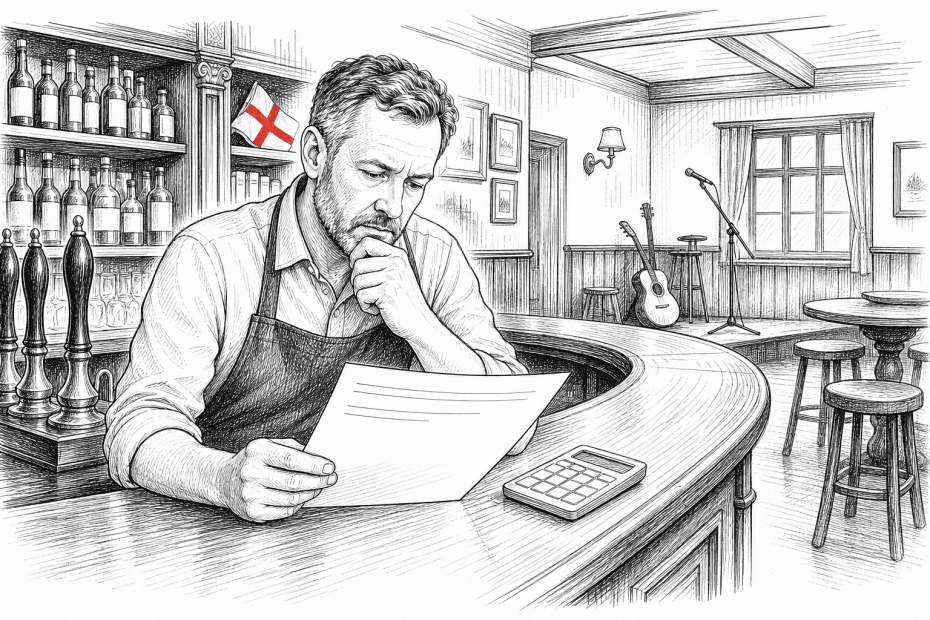
Pubs, social clubs and many live music venues in England are set to receive a further 20% cut to their business rates from April 2027. The government estimates that almost 32,000 venues could benefit, with an average saving of about £1,100 next year.
For independent operators, the announcement offers welcome breathing room after sharp increases in property and staffing costs. However, it is not yet a figure that businesses should treat as guaranteed cash: detailed eligibility rules will not be confirmed until the Chancellor’s autumn Budget.
What has been announced?
The new discount is intended to apply to pubs, social clubs and eligible live music venues in England. It will sit on top of the 15% relief introduced for pubs and music venues earlier in 2026, rather than replacing that support.
The government says the additional measure will cost £100 million. It plans to fund the policy through a review of tax reliefs for businesses such as vape shops and gambling arcades, alongside action against sellers using online marketplaces without meeting their tax obligations.
The largest live music venues will not qualify. Nightclubs are also outside the announcement, although the government says they already receive lower business rates multipliers and other support. Where a venue does not fit neatly into one category, the final definitions will be important.
Why the detail matters for small venues
Business rates are based on a property’s rateable value, so the actual saving will vary considerably between premises. The government’s £1,100 estimate is an average, not a flat payment or a promise that every qualifying venue will save that amount.
Eligibility can also be complicated for mixed-use businesses. A pub that hosts occasional music, a members’ club that hires out rooms, or a venue that operates differently at night may need to wait for the formal rules before knowing exactly how it will be treated.
Under existing relief, local authorities can decide whether venues qualify when their status is unclear. The forthcoming scheme is expected to use similar definitions. Operators should therefore keep accurate evidence of how their premises are used and check the billing authority’s guidance once the policy is finalised.
Restaurants, hotels and nightclubs remain outside the cut
The announcement is narrower than the hospitality industry had sought. Hotels and restaurants are not included, prompting concern that businesses facing many of the same wage, energy and supply pressures will receive no equivalent reduction.
UKHospitality described the move as a good start but called for a broader solution at the autumn Budget. The Federation of Small Businesses similarly said it should be a “downpayment” on action for the wider small-business community.
This distinction could be particularly awkward for businesses that combine several activities. A hotel with a public bar, a restaurant with regular live performances or a late-night venue may not be able to infer its position from the headline alone. Owners should avoid assuming that one part of the operation makes the whole property eligible.
What pub and venue owners should do now
The discount is due to begin next April, so there is no immediate application deadline. There are still useful steps operators can take before the Budget:
- check the property’s current rateable value and the assumptions behind the latest bill;
- confirm that existing reliefs have been correctly applied by the local authority;
- keep records showing the venue’s main use, opening model and live-music activity;
- prepare cash-flow forecasts both with and without the expected saving;
- watch for the autumn Budget and subsequent council guidance on eligibility; and
- seek professional rating advice if the property’s classification or valuation appears wrong.
Businesses should also be wary of unsolicited agents promising guaranteed reductions or requesting large upfront fees. A legitimate review of a rates bill should be based on the property’s facts and the published rules, not simply the political announcement.
A useful saving, but not a complete answer
For a small pub, £1,100 can help cover part of an energy bill, equipment repair or supplier increase. Yet many operators have seen costs rise by far more, and some previously missed out on support because of the way their premises were classified.
The best approach is to treat the new discount as a likely reduction from April 2027, subject to the Budget and local implementation. Operators can use the next few months to make sure their current bill is accurate, preserve evidence for any eligibility decision and avoid building an uncertain saving into essential spending.